A HYBRID DATASET-BASED ENSEMBLE STRATEGY FOR EFFICIENT BREAST CANCER DETECTION
DOI:
https://doi.org/10.71146/kjmr777Keywords:
Machine Learning, Detection of Breast Cancer, Computer Vision, Deep Learning, Classification of Breast cancerAbstract
Breast cancer is especially dangerous for women because it kills and hurts a lot of people. Because of this, there is a need for an algorithm that can spot the first signs of breast cancer essential. One of the most common types of cancer in women is breast cancer. Its spread among people is a major worry all over the world. To save the patient's life, it is very important to find the disease and treat it right away. Last year, more than 2.3 million women were told they had breast cancer, and about 0.7 million of them died. Manually diagnosing the disease isn't very good, and most of the time, it's almost impossible to find severe cancer early, which means that the patients die. Machine learning is a key part of figuring out what early signs of breast cancer to look for.
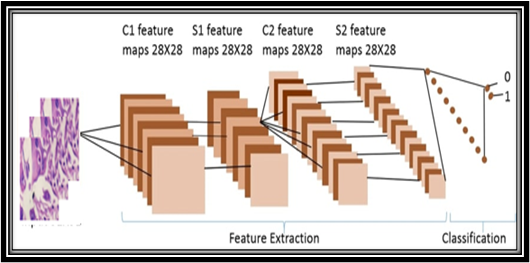
In this paper Machine Learning (ML) and Deep Learning (DL) methods can be used to find breast cancer in early stage and accurately to save lives. In this work breast cancer predicted by using a hybrid model to combine ML and DL techniques. Firstly, a DL method Scale-Invariant Feature Transform (SWIFT) is used to extract the meaning full information from the image dataset and then different machine learning models such as (K-Nearest Neighbors (KNN), Random Forest (RF) and Support Vector Machine (SVM)) are applied to classify the malignant and benign cases. Secondly, these models classified the instances into two classes. The main focus of this work is to figure out whether a breast cancer is benign or malignant based on different specific characteristics taken from a group of images from normal and breast cancer patients. The results of contracted ML models compared on the basis of accuracy, precision, Recall and F1-Score. This study used Principal Component Analysis to find the optimized features from the set of extracted features for improving the accuracy of the used models. This is done by using multiple Machine Learning algorithms and choosing the classification model with the highest accuracy.
Downloads
Downloads
Published
Issue
Section
Categories
License
Copyright (c) 2025 Muhammad Sajid Maqbool, Nosheen Fatima, Rubaina Nazeer, Naeem Aslam, Faisal Abbas , Unaiza Sumra, Muqadas Nadeem (Author)

This work is licensed under a Creative Commons Attribution 4.0 International License.
How to Cite