DISCRETIZATION OF LAPLACIAN OPERATOR IN POLAR COORDINATE SYSTEM, USING CRANK-NICOLSON’S (CN) SCHEME AND STABILITY ANALYSIS
DOI:
https://doi.org/10.71146/kjmr844Keywords:
Laplacian operator, Crank-Nicolson’s scheme, Discretization, Polar coordinate systemAbstract
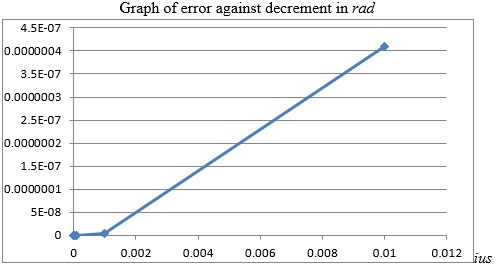
Laplacian operator plays a vital role for describing and solving many mathematical models. Finite difference Scheme of Laplacian operator has been carried out by various researchers using Euler’s scheme but unfortunately the scheme is stable for very small ratio of k/h2. However, Crank-Nicolson’s scheme has been proved stable for all values of k/h2. In this contribution discretization of Laplacian operator in polar coordinate system will be carried by using Crank-Nicolson’s Scheme. Stability analysis has been carried out for the scheme and results are compared with previous research analysis. The obtained isotropic discretized laplacian operator on the 5-points stencil on the polar grid system shows stable and accuracy as compared to previously obtained discretization using explicit finite difference scheme. The result obtained on various sizes of polar mesh system shows that the error of the isotropic discrete laplacian decreases rapidly with each step time step of the computation scheme. The derived isotropic discretized laplacian scheme on the polar net system is highly useful for employing and studying various computational models. The acquired discretization of the polar laplacian scheme on the circular annular plane is potential candidate for significant results for the CDS (Cell Dynamic Simulations) model used for advanced materials and image processing used for computational studies. Centre of the circle and its neighborhood have been avoided in this study due to the limitations of laplacian operator in the polar coordinate system.
Downloads
Downloads
Published
Issue
Section
Categories
License
Copyright (c) 2026 Raunaque Ali Rid, Mazhar Ali Sahito, Akhlaque Ahmed Abbasi, Afshan Parveen Dehraj, Majida Mallah (Author)

This work is licensed under a Creative Commons Attribution 4.0 International License.
How to Cite