ADVANCED HYBRID ENERGY STORAGE SYSTEMS INTEGRATING BATTERIES, SUPERCAPACITORS, AND PHOTOVOLTAIC DEVICES FOR SUSTAINABLE POWER CONVERSION AND EFFICIENCY OPTIMIZATION
DOI:
https://doi.org/10.71146/kjmr805Keywords:
Hybrid energy storage, Photovoltaic integration, supercapacitors, Battery management, Energy efficiency optimizationAbstract
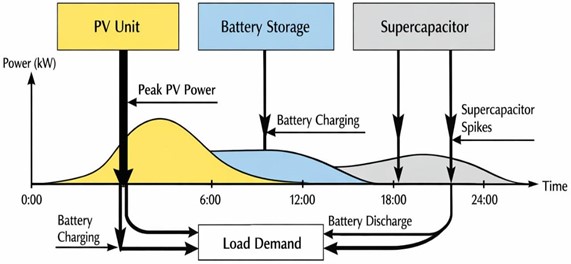
The global transition toward sustainable energy demands efficient and reliable power conversion systems. Conventional energy storage technologies struggle to meet dynamic load requirements and intermittency issues associated with renewable sources. This study proposes an advanced hybrid energy storage system that integrates batteries, supercapacitors, and photovoltaic devices into a unified architecture. The objective is to enhance energy efficiency, system stability, and power delivery performance. Photovoltaic devices serve as the primary renewable energy source. However, their output fluctuates due to environmental conditions. Batteries provide high energy density and ensure long-term energy availability. Supercapacitors complement batteries by offering high power density and rapid charge–discharge capability. The coordinated integration of these components creates a balanced system that addresses both energy and power demands. A novel energy management strategy is introduced to control power flow among the subsystems. The strategy prioritizes photovoltaic utilization while minimizing battery stress. Supercapacitors handle transient loads and peak power demands. This approach reduces energy losses and extends battery lifespan. System efficiency is further improved through optimized power conversion techniques. Simulation-based analysis demonstrates improved voltage stability, faster dynamic response, and reduced conversion losses compared to conventional single-storage systems. The hybrid configuration shows superior adaptability under varying load and irradiation conditions. Results confirm that the proposed system achieves higher efficiency and operational reliability. The findings highlight the potential of hybrid energy storage systems for sustainable power applications. Such systems are suitable for smart grids, electric vehicles, and standalone renewable installations.
Downloads
Downloads
Published
Issue
Section
Categories
License
Copyright (c) 2026 Sohaib Khan, Sidra Parveen, Muhammad Azam Shani, Amama Sattar, Shaheen Irfan, Muhammad Arslan Haider Shah, Javed Karim, Iftekhar Majeed, Muhammad Deebaj (Author)

This work is licensed under a Creative Commons Attribution 4.0 International License.
How to Cite