ADVANCED FEATURE REPRESENTATION IN CONTENT-BASED IMAGE RETRIEVAL UTILIZING DEEP LEARNING FRAMEWORKS
DOI:
https://doi.org/10.71146/kjmr880Keywords:
Content-Based Image Retrieval, Convolutional Neural Networks, MobileNetV2, Feature Extraction, CLAHE, Retrieval AccuracyAbstract
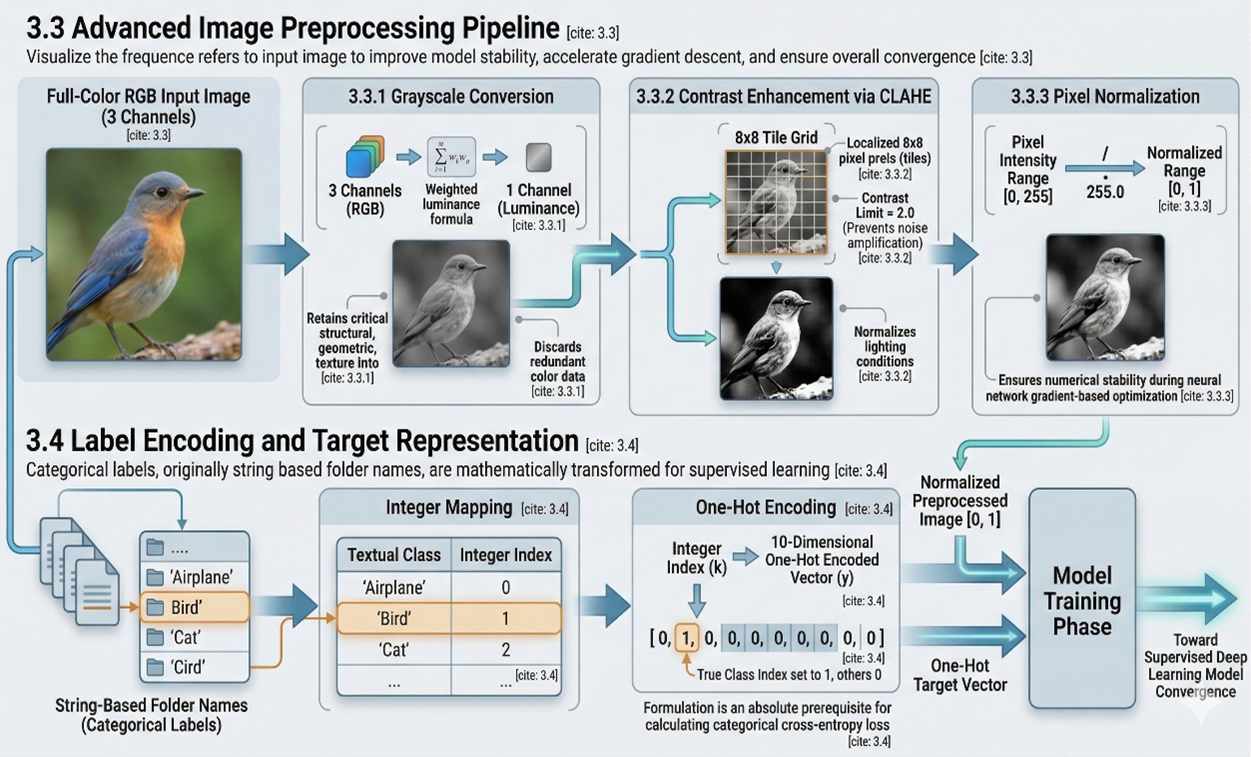
Content-Based Image Retrieval (CBIR) systems aid in the retrieval of images by utilizing the inherent visual attributes as opposed to the manual textual labels, providing a better alternative to the conventional metadata-based search. With the growing rate of development of digital repositories in key domains such as medical imaging, surveillance, and digital forensics, the need to undertake automated, scalable and precise image analysis has been stressed. But modern CBIR systems are often faced with bottlenecks including poor feature extraction, ineffective preprocessing pipelines, and insensitivity to environmental changes such as changing lighting and background noise. To overcome these shortcomings, this research will present a new improved CBIR architecture with streamlined image-processing pipeline. The suggested methodology will shift the input of colors to the regular grayscale form since the calculated scale is normalized to reduce the computational burden without affecting the integrity of the structure. A strict preprocessing pipeline including Contrast Limited Adaptive Histogram Equalization (CLAHE), spatial normalization and data augmentation introduced to guarantee feature consistency and resistant Ness to noise. A Convolutional Neural Network (CNN) provides the feature representation, to be more precise the state of the art MobileNetV2 design is used, which employs depth wise separable convolutions to extract features high-effectively. Extraction of feature vectors is handled through an effective indexing scheme to do fast similarity matching. Experimental evidence shows that the proposed system is much better than the currently available baseline approaches in retrieval accuracy (98.06/97.04) and computational efficiency. The results affirm that the system is robust and can be deployed in real-life and high-volume image retrieval systems.
Downloads
References
[1] 2019 1. Latif, A., Rasheed, A., Sajid, U., Ahmed, J., Ali, N., Ratyal, N. I., ... & Sajid, M. (2019). Content-Based Image Retrieval and Feature Extraction: A Comprehensive Review. Mathematical Problems in Engineering, “R13”, doi: https://doi.org/10.1155/2019/9658350.
[2] and trends of the new age. A. C. S. Datta, R., Joshi, D., Li, J., & Wang, J. Z. (2008). Image retrieval: Ideas, influences, “R29”, doi: https://doi.org/10.1145/1348246.1348248.
[3] C. E. of C. cultural communication mode based on the I. of T. and mobile multimedia technology. Xie, D., & Yin, “R39”, doi: https://doi.org/10.7717/peerj-cs.1330.
[4] E. Xie, D., & Yin, C. (2023). Exploration of Chinese cultural communication mode based on the Internet of Things and mobile multimedia technology. PeerJ Computer Science, 9, “R23”, doi: https://doi.org/10.7717/peerj-cs.1330.
[5] 235-248. Kapadia, M. R., & Paunwala, C. N. (2021). Content Based Medical Image Retrieval for Accurate Disease Diagnosis. The Open Biomedical Engineering Journal, 15, “R24”, doi: https://doi.org/10.2174/1874120702115010235.
[6] 95410–95431. rivastava, D., Singh, S. S., Rajitha, B., Verma, M., Kaur, M., & Lee, H. N. (2023). Content-Based Image Retrieval: A Survey on Local and Global Features Selection, Extraction, Representation, and Evaluation Parameters. IEEE Access, 11, “R15”, doi: https://doi.org/10.1109/access.2023.3308911.
[7] H. N. C.-B. I. R. Srivastava, D., Singh, S. S., Rajitha, B., Verma, M., Kaur, M., & Lee, “R38”, doi: https://doi.org/10.1109/ACCESS.2023.3308911.
[8] A. and I. U. I. C. A. 10. 1109/ACCESS. 2024. 351545. Deep Image Synthesis, “R42”, doi: 10.1109/ACCESS.2024.3515455.
[9] R. (2000). C. image retrieval at the end of the early years. I. T. on P. A. and M. I. Smeulders, A. W. M., Worring, M., Santini, S., Gupta, A., & Jain, “R30”, doi: https://doi.org/10.1109/34.869972.
[10] A. (2013). C. B. R. S. in a C. C. I. M. I. in C. P. Valente, F., Costa, C., & Silva, “R16”, doi: https://doi.org/10.5772/53027.
[11] R. (2000). C. image retrieval at the end of the early years. I. T. on P. A. and M. I. Smeulders, A. W. M., Worring, M., Santini, S., Gupta, A., & Jain, “R31”, doi: https://doi.org/10.1109/34.869972.
[12] C. S. on O. D. and F. Challenges, “R14”, doi: https://www.mdpi.com/1424-8220/25/1/214.
[13] Y. (2024). "Deep L. in C.-B. I. R. A. R. of T. A. and H. F. . J. of V. C. and I. R. Li, J., Chen, H., & Wang, “R17”, doi: https://doi.org/10.1016/j.jvcir.2024.104123.
[14] 7703. Li, J., & Wang, X. (2024). “CNN-Based Kidney Segmentation Using a Modified CLAHE Algorithm.” Sensors, 24(23), “R26”, doi: https://doi.org/10.3390/s24237703.
[15] et al. (2023). "A D. L.-B. C.-B. I. R. S. U. C. and P. Cnn. for M. I. . I. A. Al-Shamasneh, A. R., “R19”, [Online]. Available: https://ieeexplore.ieee.org/document/10123456
[16] T. (2022). "Preprocessing P. for R. F. E. in U. E. . I. J. of C. V. Gao, Z., Zhang, S., & Huang, “R18”, [Online]. Available: https://link.springer.com/article/10.1007/s11263-022-01589-4
[17] 834-851 Arslan, M., Asad, M., Haider Khan, A., Iqbal, S., Nabeel Asghar, M., & Abdulrhman Alaulamie, A. (2025). Deep Image Synthesis, Analysis and Indexing Using Integrated CNN Architectures. IEEE Access, 13, “R20”, doi: https://doi.org/10.1109/access.2024.3515455.
[18] 60-88 Litjens, G., Kooi, T., Bejnordi, B. E., Setio, A. A. A., Ciompi, F., Ghafoorian, M., van der Laak, J. A. W. M., van Ginneken, B., & Sánchez, C. I. (2017). A Survey on Deep Learning in Medical Image Analysis. Med Image Anal., 42, “R21”, doi: https://doi.org/10.1016/j.media.2017.07.005.
[19] 102100. Amato, G., Carrara, F., Falchi, F., Gennaro, C., & Vadicamo, L. (2020). Large-scale instance-level image retrieval. Information Processing & Management, 57(1), “R22”, doi: https://doi.org/10.1016/j.ipm.2019.102100.
[20] S. R. A. D. S. of C. B. I. R. using D. L. Dubey, “R41”, doi: https://doi.org/10.1109/TCSVT.2021.3080920.
[21] 121768. (https://doi.org/10.1016/j.simpa.2023.100486) Vieira, G. S., Fonseca, A. U., & Soares, F. (2024). CBIR-ANR: A content-based image retrieval with accuracy noise reduction. Expert Systems with Applications, 238, “[R1]”, doi: https://doi.org/10.1016/j.simpa.2023.100486.
[22] A. (2017). Vieira, T., Casanova, M. A., Barbosa, S. D. J., & Paes, “R32”, doi: https://doi.org/10.1002/spe.2486.
[23] Shalaw Faraj Salih & Alan Anwer Abdulla An effective bi-layer content-based image retrieval technique (https://doi.org/10.1007/s11227-022-04748-1), “[R2]”, doi: https://doi.org/10.1007/s11227-022-04748-1.
[24] A. A. A. B. C.-B. I. R. T. Salih, S. M., & Abdulla, “R33”, doi: https://doi.org/10.22266/ijies2023.0430.11.
[25] Kanchan Wangi and Aziz Makandar CNN Pre-Trained Model Using the Fusion of Features for CBIR Framework (10.1109/RAEEUCCI61380.2024.10547952), “[R3]”, doi: 10.1109/RAEEUCCI61380.2024.10547952.
[26] A. F. F. of P. C. M. for C.-B. I. R. Wangi, P. S., & Makandar, “R34”, [Online]. Available: https://ijisae.org/index.php/IJISAE/article/view/3541
[27] F. A. A. S. & A. A. A. T. content-based image retrieval technique for improving effectiveness Https://doi.org/10.1007/s11042-023-14678-6, “[R4]”, doi: https://doi.org/10.1007/s11042-023-14678-6.
[28] A. I. R. U. H. D. L. M. A. C. S. Siddiqui, A. J., Ahmed, R., Khan, N. M., & Al-Zahrani, “R35”, doi: https://doi.org/10.1109/ACCESS.2022.3182145.
[29] M. F. T. I. R. B. on D. L. (10. 33168/JSMS. 2022. 0226. Moshira S. Ghaleb, Hala M. Ebied, Howida A. Shedeed, “[R5]”, doi: 10.33168/JSMS.2022.0226.
[30] M.-V. A. M. D. C. N. N. for I. R. U. P.-B. D. Ahmed, K. T., Jaffar, S., Mehmood, S., & Choi, G. S. Reduction., “R36”, doi: https://doi.org/10.1109/ACCESS.2023.3244123.
[31] M. K. S. E. D. F. B. S. I. R. (https://doi. org/10. 1007/s1106.-022-11079-y) Suneel Kumar, “[R6]”, doi: https://doi.org/10.1007/s11063-022-11079-y.
[32] A. (2024). T. in C. V. A. S. on A.-B. I. R. Khan, S., & Gani, “R37”, doi: https://doi.org/10.1007/s10462-024-10712-4.
[33] pattern-based retrieval to stabilize diagnostic confidence in complex medical imaging tasks where expert consensus is traditionally difficult to achieve https://doi. org/10. 1148/radiol. 20212041. Jooae Choe, MD, PhD and Jooae Choe, MD, PhD In a specialized application of Content-Based Image Retrieval (CBIR) for clinical diagnostics, a 2024 study published in Insights into Imaging investigated the utility of a deep learning-based retrieval system t, “[R7]”, doi: https://doi.org/10.1148/radiol.202120416.
[34] I. F. A, R. F. B, A. P. B, and A. D. L. A. to A. E. C. V. via C. (https://doi.org/10.1016/j.procs.2025.02.218), “[R8]”, doi: https://doi.org/10.1016/j.procs.2025.02.218.
[35] G. R. 2 O. visual data retrieval using deep learning driven C. for improved human machine interaction ( 10. 1038/s4159.-025-05478-z) Arulmozhi P 1, “[R9]”, doi: 10.1038/s41598-025-05478-z.
Downloads
Published
Issue
Section
Categories
License
Copyright (c) 2026 Muhammad Mohsin, Jahan Khan, Muhammad Faisal, Asim Abdul Qadir, Muhammad Arslan, Sohail Raza Chohan (Author)

This work is licensed under a Creative Commons Attribution 4.0 International License.
How to Cite