HIGH-EFFICIENCY LEAD-FREE PEROVSKITE SOLAR CELLS: INSIGHTS FROM PARAMETER OPTIMIZATION IN RbGeI3 DEVICES VIA DEVICE SIMULATION
DOI:
https://doi.org/10.71146/kjmr631Keywords:
Lead-Free perovskite Solar cell, Numerical Simulation, SCAPS 1-D, RbGeI3, Optoelectrical Performance, IGZO ETL, CuSbS2 HTLAbstract
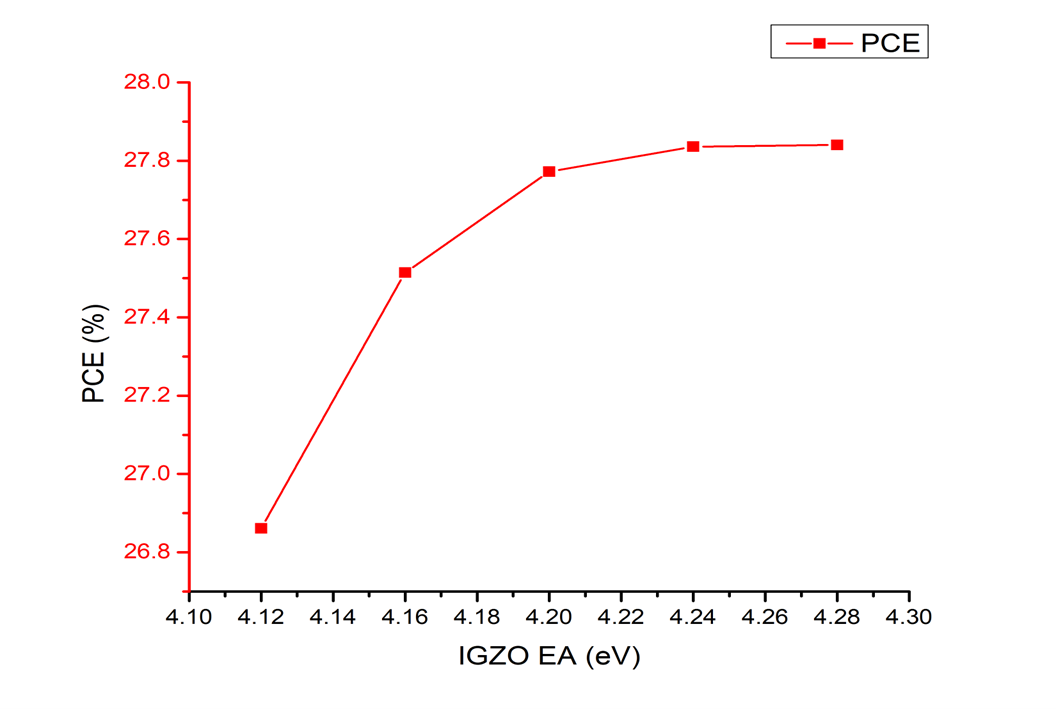
Perovskite solar cells (PSCs) have attracted considerable interest in recent years owing to their remarkable power conversion efficiencies and promising prospects for cost-effective fabrication. This study reports the numerical optimization of a thin-film perovskite solar cell architecture consisting of FTO/IGZO/RbGeI3/CuSbS2/Au, where IGZO functions as the electron transport layer, RbGeI3 serves as the light-harvesting perovskite absorber, and CuSbS2 is employed as the hole transport layer. A systematic variation of the absorber, ETL, and HTL layer thicknesses, along with their respective electron affinities, was conducted to evaluate the impact on key photovoltaic parameters, including the VOCJSC, FF, and PCE. The optimized absorber thicknesses markedly enhance JSC and PCE, achieving a maximum efficiency of approximately 29.3% with a 700 nm RbGeI3 layer. The electron affinity of IGZO was found to play a critical role in facilitating efficient charge extraction, with the highest PCE obtained at 4.28 eV. Likewise, modulation of the CuSbS2 HTL thickness yielded progressive improvements in PCE, reaching up to 29.37%. The concurrent optimization of thickness parameters and interfacial band alignment led to substantial increases in FF and overall device efficiency. This establishes a useful reference point for advancing future research in this field.
Downloads
Downloads
Published
Issue
Section
Categories
License
Copyright (c) 2025 Azhar Nawaz, Muhammad Yasir Nawaz Khan, Ayaz Husnain (Author)

This work is licensed under a Creative Commons Attribution 4.0 International License.
How to Cite