DYNAMIC ANALYSIS OF SINGLE ACTIVE BRIDGE DC-DC CONVERTER DURING LINE VARIATION
DOI:
https://doi.org/10.71146/kjmr614Keywords:
SAB Converter, Cascaded Control, Line Variation, State-Space Modeling, PI Controller, Renewable Energy, HVDC, MVDC, Solid-State Transformer, Electric VehicleAbstract
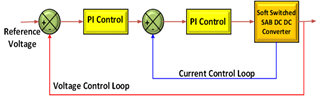
With the growing need for high-efficiency power conversion in renewable energy, transport and grid applications, research on innovative DC-DC converter topologies has been accelerated. Among these, Single Active Bridge (SAB) converter has received much attention for its structural simplicity, compactness, and low switching losses. However, the performance of the resulting system is limited when controlled using conventional proportional-integral (PI) control schemes due to the presence of oscillations, voltage overshoot and poor dynamic performance under line disturbances. This paper reports a comprehensive dynamic analysis of SAB converter under step-to-step line variation using a cascaded control strategy with inner current loop and outer voltage loop. The converter is modeled in state-space averaging, the transfer functions of voltage and current loops are derived, and then the model is simulated in MATLAB/Simulink under different supply conditions. As shown in Figures 8 and 9 with the summary of results in Table 1, the cascaded control has a smaller peak-to-peak overshoot and better settling time than the single-loop PI control because the maximum overshoot is 25 V and 27 V for the line increase and line drop tests, respectively. Furthermore, SAB converter applications in renewable energy systems, solid-state transformers, electric vehicles, and future HVDC/MVDC networks are also discussed to show the versatility of the topology. The results show that cascaded control increases the robustness of SAB converters against the perturbation, therefore these converters are better candidates for the next generation high power and renewable energy applications.
Downloads
Downloads
Published
Issue
Section
Categories
License
Copyright (c) 2025 Dr. Saad Khan Baloch, Abdul Hameed Soomro, Numan Ali (Author)

This work is licensed under a Creative Commons Attribution 4.0 International License.
How to Cite