RESCUE FACILITATION THROUGH AUTONOMOUS VEHICULAR AD HOC NETWORKS
DOI:
https://doi.org/10.71146/kjmr980Keywords:
Health Sciences Research , AI-Driven Threat Mitigation, Rescue, VanetAbstract
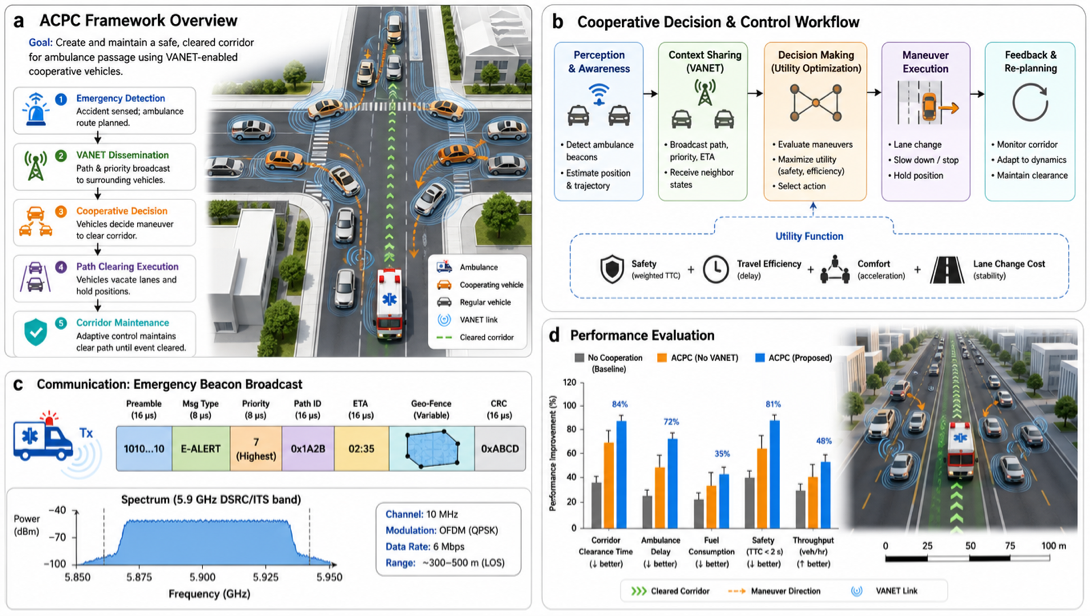
The rapid development of wireless communication networks has facilitated the emergence of Vehicular Ad Hoc Networks (VANETs), enabling critical applications in road safety, traffic efficiency, and intelligent transportation systems. Among these applications, the facilitation of emergency services, particularly ambulance routing and path clearing, stands out as a crucial area where rapid data transmission can directly save lives. However, achieving reliable and secure ambulance traversal through congested urban environments presents significant challenges, primarily due to the high mobility of network nodes and the constant threat of cyber-attacks. This paper proposes a comprehensive framework for ambulance rescue operations leveraging a network of autonomous vehicles connected via VANET. By systematically reviewing existing literature on routing protocols, network topology governance, and cybersecurity, this study develops a multi-layered approach that integrates secure broadcasting, dynamic topology adjustment, and cooperative vehicle dispersal. Furthermore, a hypothetical evaluation plan is presented to rigorously test the proposed framework using advanced simulation tools. Ultimately, this research highlights the necessity of secure, scalable, and dynamically adaptable VANET architectures to support the life-saving missions of emergency response vehicles in future smart cities.
Downloads
References
Samara, Ghassan. "Security Analysis of Vehicular Ad Hoc Networks (VANET)." 2012. https://doi.org/10.1109/NETAPPS.2010.17
Moawad, Hafez, et al. "Stop_times based Routing Protocol for VANET." International Journal of Computer Applications 81(18):4-9, November 2013. Published by Foundation of Computer Science, New York, USA, 2013. https://doi.org/10.5120/14221-2029
Samara, Ghassan, and Yousef Al-Raba'nah. "Security Issues in Vehicular Ad Hoc Networks (VANET): a survey." International Journal of Sciences & Applied Research, 2015, 2017. https://arxiv.org/pdf/1712.04263v1
Mukhtaruzzaman, Mohammad, and Mohammed Atiquzzaman. "Clustering in VANET: Algorithms and Challenges." Computers & Electrical Engineering, Volume 88, December 2020, 106851, 2020. https://doi.org/10.1016/j.compeleceng.2020.106851
Shakib, Kazi Hassan, et al. "Quantum Cyber-Attack on Blockchain-based VANET." 2023. https://arxiv.org/pdf/2304.04411v2
Ren, Ruixing, et al. "Towards Governance of Localized VANET: An Adjustable Degree Distribution Model." 2026. https://arxiv.org/pdf/2601.21176v1
Danquah, Wiseborn Manfe, and Turgay D Altilar. "HYBRIST Mobility Model- A Novel Hybrid Mobility Model for VANET Simulations." IJCA 86(14):15-21, January 2014, 2014. https://doi.org/10.5120/15053-3408
Monteiro, Romeu, et al. "Improving VANET Protocols via Network Science." R. Monteiro, S. Sargento, W. Viriyasitavat, and O. K. Tonguz, "Improving VANET Protocols via Network Science", in Proceedings of the 2012 IEEE Vehicular Networking Conference (VNC), Korea, November 2012, 2013. https://doi.org/10.1109/VNC.2012.6407428
Wang, Pengfei, et al. "Cellular V2X in Unlicensed Spectrum: Harmonious Coexistence with VANET in 5G systems." 2017. https://arxiv.org/pdf/1712.04639v2
Mukhtaruzzaman, Mohammad, and Mohammed Atiquzzaman. "Cloud based VANET Simulator (CVANETSIM)." 2021. https://arxiv.org/pdf/2101.11147v1
Downloads
Published
Issue
Section
Categories
License
Copyright (c) 2026 Saeed Ur Rehman, Dr Anum Ali (Author)

This work is licensed under a Creative Commons Attribution 4.0 International License.
How to Cite