INTRUSION DETECTION SYSTEM ON FEMTOCELLS OF SMART HOMES: A FEDERATED HYBRID APPROACH
DOI:
https://doi.org/10.71146/kjmr976Keywords:
AI statistics, IoT wearables, Cardiovascular Disease AwarenessAbstract
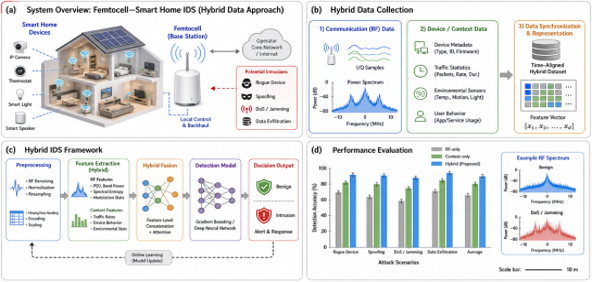
The rapid proliferation of Internet of Things (IoT) devices has transformed traditional residences into smart homes, bringing unprecedented convenience but simultaneously exposing users to severe cybersecurity threats. To manage the vast amount of generated data and improve local wireless coverage, femtocell access points have emerged as a critical underlaying communication infrastructure in next-generation networks. However, these femtocells often act as centralized gateways for domestic IoT traffic, creating a vulnerable bottleneck that malicious actors can exploit to gain unauthorized access to private networks. This paper proposes a novel framework for an Intrusion Detection System (IDS) deployed directly at the smart home femtocell level, leveraging a combination of hybrid deep learning and federated learning techniques. By shifting the computational burden away from resource-constrained edge devices to the more capable femtocell access point, the proposed architecture provides robust, real-time threat detection. Furthermore, a federated learning strategy allows multiple smart home femtocells to collaboratively train intrusion detection models with a macrocell without exchanging sensitive, privacy-compromising household data. Through a comprehensive design and hypothetical evaluation plan, this paper demonstrates how combining active learning for alert management with distributed deep learning can significantly enhance the security posture of smart home environments.
Downloads
References
Alsakran, Faisal, Bendiab, Gueltoum, Shiaeles, Stavros, & Kolokotronis, Nicholas (2021). Intrusion Detection Systems for Smart Home IoT Devices: Experimental Comparison Study. International Symposium on Security in Computing and Communication. SSCC 2019: Security in Computing and Communications. https://doi.org/10.1007/978-981-15-4825-3_7
Pantisano, Francesco, Bennis, Mehdi, Saad, Walid, & Debbah, Mérouane (2011). Spectrum Leasing as an Incentive towards Uplink Macrocell and Femtocell Cooperation. https://doi.org/10.1109/JSAC.2012.120411
Elsayed, Nelly, Zaghloul, Zaghloul Saad, Azumah, Sylvia Worlali, & Li, Chengcheng (2021). Intrusion Detection System in Smart Home Network Using Bidirectional LSTM and Convolutional Neural Networks Hybrid Model. https://arxiv.org/pdf/2105.12096v2
Ranjan, Ravi, & Sahoo, G. (2014). A New Clustering Approach for Anomaly Intrusion Detection. International Journal of Data Mining & Knowledge Management Process (IJDKP),ISSN:2230-9608[Online],2231-007X[Print] Vol.4, No.2, March 2014, page(s): 29-38. https://doi.org/10.5121/ijdkp.2014.4203
Belenguer, Aitor, Navaridas, Javier, & Pascual, Jose A. (2022). A review of Federated Learning in Intrusion Detection Systems for IoT. https://arxiv.org/pdf/2204.12443v2
McElwee, Steven, & Cannady, James (2019). Cyber Situation Awareness with Active Learning for Intrusion Detection. IEEE SoutheastCon (2019) 1-7. https://doi.org/10.1109/SoutheastCon42311.2019.9020599
Atli, Buse Gul, & Jung, Alexander (2018). Online Feature Ranking for Intrusion Detection Systems. https://arxiv.org/pdf/1803.00530v2
Kale, Rahul, Lu, Zhi, Fok, Kar Wai, & Thing, Vrizlynn L. L. (2022). A Hybrid Deep Learning Anomaly Detection Framework for Intrusion Detection. IEEE 8th Intl Conference on Big Data Security on Cloud (BigDataSecurity), IEEE Intl Conference on High Performance and Smart Computing,(HPSC) and IEEE Intl Conference on Intelligent Data and Security (IDS), pp. 137-142. IEEE, 2022. https://doi.org/10.1109/BigDataSecurityHPSCIDS54978.2022.00034
Trivedi, Animesh Kr, Arora, Rajan, Kapoor, Rishi, Sanyal, Sudip, & Sanyal, Sugata (2010). A Semi-distributed Reputation Based Intrusion Detection System for Mobile Adhoc Networks. Trivedi et al., "A Semi-distributed Reputation Based Intrusion Detection System for Mobile Adhoc Networks". Journal of Information Assurance and Security (JIAS), Volume 1, Issue 4, December 2006, pp. 265-274. https://arxiv.org/pdf/1006.1956v2
Harang, Richard, & Kott, Alexander (2017). Burstiness of Intrusion Detection Process: Empirical Evidence and a Modeling Approach. https://arxiv.org/pdf/1707.03927v1
Downloads
Published
Issue
Section
Categories
License
Copyright (c) 2026 Dr Anum Ali, Dr M Hussain, Dr Junaid Arshad, Dr M Aslam, Bahman R Alyaei, Ali Ahmed (Author)

This work is licensed under a Creative Commons Attribution 4.0 International License.
How to Cite