COMPARATIVE ANALYSIS OF ORGANIC AND CHEMICALLY PROCESSED FOODS THROUGH AI-ASSISTED STATISTICAL EVALUATION USING SHAP, LIME AND NNQ ALGORITHMS.
DOI:
https://doi.org/10.71146/kjmr970Keywords:
Food statistics , AI Data Analytics , Algorithm classification, SHAP, LIME, NNQAbstract
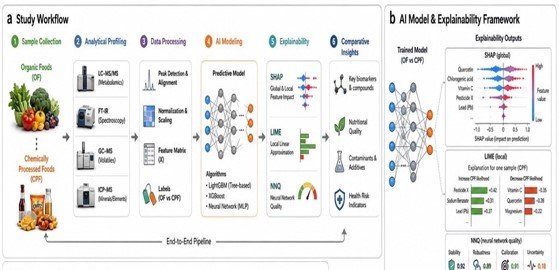
This study employs advanced AI-driven statistical analyses to compare organic and processed foods across multiple dimensions, including nutritional content, health outcomes, consumer behavior, and environmental impact. AI models reveal significant nutritional differences, with organic foods exhibiting higher levels of vitamins and antioxidants and lower pesticide residues, while processed foods contain more additives. Predictive machine learning models associate organic food consumption with reduced risks of chronic diseases, contrasting with the elevated health risks linked to processed food intake. Consumer sentiment analysis and clustering algorithms highlight distinct preference patterns favoring organic products for health and environmental reasons. Environmental assessments demonstrate lower carbon footprints and water usage in organic food production. Robustness checks, including cross-validation, sensitivity analyses, and confounder controls, ensure model reliability and fairness. Explainability techniques such as SHAP and LIME enhance transparency and bias detection. This comprehensive AI statistical framework advances understanding of the complex differences between organic and processed foods, supporting informed consumer and policy decisions.
Downloads
References
Cubero-Leon, E., De Rudder, O., & Maquet, A. (2018). Metabolomics for organic food authentication: Results from a long-term field study in carrots. ncbi.nlm.nih.gov
Tsakanikas, P., Karnavas, A., Z. Panagou, E., & Nychas, G. J. (2020). A machine learning workflow for raw food spectroscopic classification in a future industry. ncbi.nlm.nih.gov
Singh, A. & Glińska-Neweś, A. (2022). Modeling the public attitude towards organic foods: a big data and text mining approach. ncbi.nlm.nih.gov
Comparative Analysis of Nearest Neighbor Query Processing Techniques. December 2015; Procedia Computer Science 57:1289-1298. DOI:10.1016/j
Przybył, K., Walkowiak, K., & Łukasz Kowalczewski, P. (2024). Efficiency of Identification of Blackcurrant Powders Using Classifier Ensembles. ncbi.nlm.nih.gov
Valenzuela, A., Zambrano, L., Velásquez, R., Groff, C., Apablaza, T., Riffo, C., Moldenhauer, S., Brisso, P., & Leonario-Rodriguez, M. (2022). Discrepancy between Food Classification Systems: Evaluation of Nutri-Score, NOVA Classification and Chilean Front-of-Package Food Warning Labels. ncbi.nlm.nih.gov
Shonkoff, E., Copeland Cara, K., (Anna) Pei, X., Chung, M., Kamath, S., Panetta, K., & Hennessy, E. (2023). AI-based digital image dietary assessment methods compared to humans and ground truth: a systematic review. ncbi.nlm.nih.gov
Australian Food and Nutrition database, www.foodstandards.gov.au. AI Live portals for coding. www.livecodes.com
Faiza, N. (2016). Food Safety, Nutritional and Economic Value of Organically and Conventionally Produced Foods.
Downloads
Published
Issue
Section
Categories
License
Copyright (c) 2026 Dr Anum Ali, Dr M Hasnain, M Aslam (Author)

This work is licensed under a Creative Commons Attribution 4.0 International License.
How to Cite