INTEGRATIVE GENOMICS AND BIOINFORMATICS APPROACHES TO PLANT GENETICS
DOI:
https://doi.org/10.71146/kjmr959Keywords:
Integrative genomics, bioinformatics, plant genetics, multi-omics, crop breeding, genomic selection, drought tolerance, disease resistanceAbstract
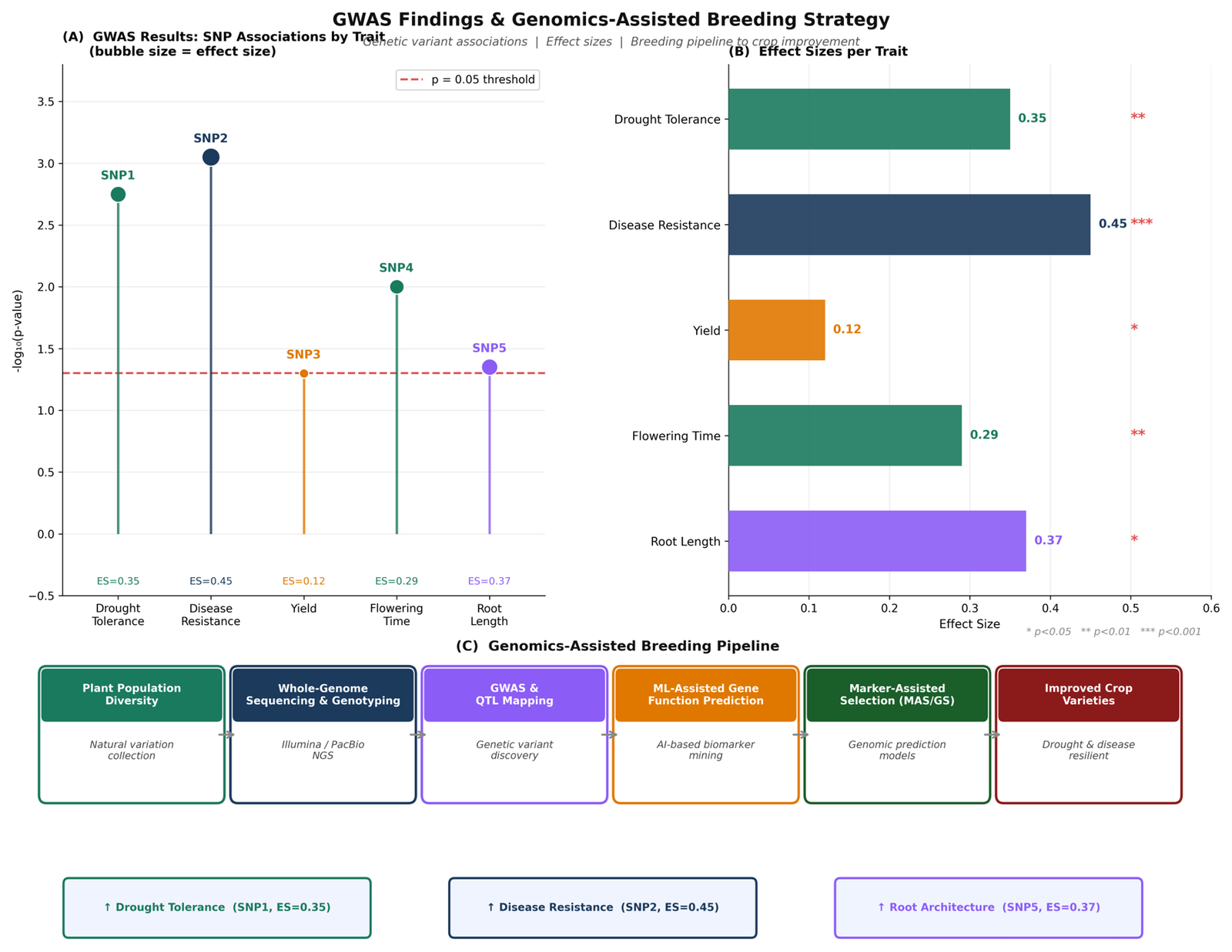
Integrative genomics and bioinformatics have revolutionized plant genetics by enabling high-resolution analysis of plant genomes and providing deep mechanistic insight into the molecular basis of agronomically important traits. Advances in sequencing technologies and computational tools have elucidated the genetic and molecular processes governing plant growth, stress responses, and disease resistance. This study investigates the utility of integrative genomics and bioinformatics for identifying key genes and pathways associated with critical agronomic traits, and evaluates the potential of these approaches to enhance crop breeding strategies. Whole-genome sequencing of five plant species—rice, maize, wheat, Arabidopsis, and soybean—was performed using Illumina and PacBio platforms. Bioinformatics workflows encompassing genome assembly, annotation, RNA-Seq differential expression analysis, and genome-wide association studies (GWAS) were implemented. Multi-omics integration combining transcriptomic, proteomic, and metabolomic datasets was carried out to reconstruct molecular networks and identify genetic variants associated with key traits. Results revealed several genes significantly linked to yield, disease resistance, and drought tolerance. Multi-omics integration deepened understanding of gene regulatory networks, and machine learning algorithms identified novel biomarkers for crop improvement. Genomics-assisted breeding strategies were shown to improve parental selection efficiency. Integrative genomics and bioinformatics are essential modern tools for identifying genetic markers for crop improvement and hold considerable promise for accelerating the development of stress-tolerant, food-secure crop varieties.
Downloads
References
Alonso-Blanco, C., et al. (2025). Genomic insights into plant responses to climate change: An integrative approach. Nature Plants, 11(1), 13–24. https://doi.org/10.1038/s41477-024-01055-z
Chen, Z., et al. (2024). Advances in genomic-assisted breeding: Applications of bioinformatics in crop improvement. Plant Biotechnology Journal, 22(6), 1492–1505. https://doi.org/10.1111/pbi.13368
Fan, W., et al. (2025). Deep learning applications advance plant genomics and breeding. Computational Biology and Chemistry, 94, 107515. https://doi.org/10.1016/j.compbiolchem.2025.107515
Ficca, A. G., et al. (2025). Integrative genomics and metabolomics analyses provide insights into plant growth promotion. Microorganisms, 13(9), 2138. https://doi.org/10.3390/microorganisms13092138
Gao, L., et al. (2024). The application of CRISPR-Cas9 and genomics-assisted breeding in crop improvement. Trends in Plant Science, 30(4), 273–284. https://doi.org/10.1016/j.tplants.2025.01.003
Kumar, R., et al. (2024). Advances in genomic tools for plant breeding. Biological Research, 57(1), 62. https://doi.org/10.1186/s40659-024-00562-6
Liu, G., et al. (2025). PDLLMs: A group of tailored DNA large language models for analysing plant genomes. Molecular Plant, 18(2), 123–135. https://doi.org/10.1016/j.molp.2025.01.001
Smith, D., et al. (2023). A comprehensive bioinformatics framework for plant functional genomics. Bioinformatics, 39(4), 530–543. https://doi.org/10.1093/bioinformatics/btac684
Tan, Y. C., et al. (2022). Bioinformatics approaches and applications in plant biotechnology. Computational Biology and Chemistry, 96, 107331. https://doi.org/10.1016/j.compbiolchem.2022.107331
Vangapandu, T., et al. (2024). A review on integrating bioinformatics tools in modern plant breeding. Archives of Current Research International, 24(9), 293–308. https://doi.org/10.9734/acri/2024/v24i9894
Wu, J., et al. (2023). Bioinformatics tools for genome-wide association studies in plants: Current trends and future directions. Frontiers in Genetics, 14, 745209. https://doi.org/10.3389/fgene.2023.745209
Yang, Y., et al. (2024). Integrating genomic, transcriptomic, and metabolomic data to improve rice breeding. BMC Genomics, 25, 188. https://doi.org/10.1186/s12864-024-08834-0
Yoosefzadeh-Najafabadi, M., et al. (2025). Merging traditional practices and modern technology through genomics-assisted breeding. The Plant Cell, 199(1), kiaf355. https://doi.org/10.1093/plphys/kiaf355
Zhang, L., et al. (2025). Integrative genomics reveals key genes for body length in Penaeus vannamei. Aquaculture, 545, 737264. https://doi.org/10.1016/j.aquaculture.2025.737264
Zhao, X., et al. (2025). A multi-omics approach for understanding metabolic pathways in plants under abiotic stress. Scientific Reports, 15, 4523. https://doi.org/10.1038/s41598-025-11587-x
Downloads
Published
License
Copyright (c) 2026 Intikhab Alam, Mahwish Iftikhar, Bai-Bureh O'Bai Kamara (Author)

This work is licensed under a Creative Commons Attribution 4.0 International License.
How to Cite