ASSOCIATION BETWEEN PSYCHOLOGICAL DISTRESS, SLEEP QUALITY AND PHYSICAL ACTIVITY LEVELS AMONG PAKISTAN NAVY MILITARY PERSONNEL: A CROSS SECTIONAL STUDY
DOI:
https://doi.org/10.71146/kjmr953Keywords:
Psychological distress , Physical activity, Navy, Military personnelAbstract
BACKGROUND: Military personnel undergo intense training and various missions for the safety of their country and its citizens. In military, the strict hierarchical structure, stress regarding promotion, collectivism, frequent job transfer cause intense psychological distress, poor sleep and low PA levels which often go unnoticed in military settings. Thus, the study aimed to assess these factors among naval personnel in Karachi.
OBJECTIVE: To determine the association between the psychological distress, sleep quality and physical activity levels among Pakistan navy military personnel
METHODOLOGY: A cross-sectional study on 217 naval personnel used convenience sampling. Data were collected using K10, PSQI, and IPAQ
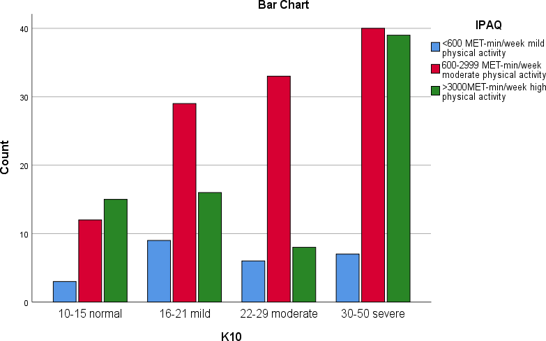
RESULT: Poor sleep (75.1%) and psychological distress (39.6%) were prevalent, while 88.4% participants had moderate to high PA levels. Distress was linked with sleep (p<0.001; H₀ rejected) and PA levels (p=0.016; H₀ rejected), while sleep-PA were non-significant (p=0.057; H₀ accepted).
CONCLUSION: In conclusion, there’s a significant associations between psychological distress and both sleep quality and PA level. However, no statistically significant relationship was found between sleep quality and PA level. Overall, psychological distress appears to play a key role in its relationship with sleep and PA among Pakistan Navy personnel.
Downloads
References
1. Agorastos A, Chrousos GP. The neuroendocrinology of stress: the stress-related continuum of chronic disease development. Mol Psychiatry. 2022; 27(1):502-513. Doi: 10.1038/s41380-021-01224-9.
2. World Health Organization. Mental health and substance use [Internet]. Geneva: WHO; 2022 [cited 2024 Jun 10]. Available from: https://www.who.int/teams/mental-health-and-substance-use
3. Hoge CW, Castro CA, Messer SC, McGurk D, Cotting DI, Koffman RL. Combat duty in Iraq and Afghanistan, mental health problems, and barriers to care. N Engl J Med. 2004; 351(1):13-22.
4. Myllylä M, Kyröläinen H, Ojanen T, Ruohola JP, Heinonen OJ, Simola P, et al. The effects of individual characteristics of the naval personnel on sleepiness and stress during two different watch keeping schedules. Int J Environ Res Public Health. 2022
5. Saguin E, Gomez-Merino D, Sauvet F, Leger D, Chennaoui M. Sleep and PTSD in the military forces: a reciprocal relationship and a psychiatric approach. Brain Sci. 2021; 11(10):1310.
6. Kiamanesh P, Mohammadi A, Maghsoudi A, Shariat SV, Haghdoost AA. The global prevalence of depression, suicide ideation, and attempts in the military forces: a systematic review and meta-analysis of cross sectional studies. BMC Psychiatry. 2021; 21(1):510.
7. Lee JH, Kim HR, Lee HE. Support from superiors reduces depression in Republic of Korea military officers. BMJ Mil Health. 2021; 167(6):378-383.
8. Peixoto EM, Zanini DS, de Andrade JM. Cross-cultural adaptation and psychometric properties of the Kessler Distress Scale (K10): an application of the rating scale model. Psicol Reflex Crit. 2021; 34(1):21.
9. Saguin E, Gomez-Merino D, Sauvet F, Leger D, Chennaoui M. Sleep and PTSD in the military forces: a reciprocal relationship and a psychiatric approach. Brain Sci. 2021; 11(10):1310.
10. Belenky G, Wesensten NJ, Thorne DR, Thomas ML, Sing HC, Redmond DP, et al. Patterns of performance degradation and restoration during sleep restriction and subsequent recovery: implications for military operational readiness. Sleep Health. 2020; 6(2):123-130.
11. Bulmer S, Aisbett B, Drain JR, Roberts S, Gusting PB, Tait J, et al. Sleep of recruits throughout basic military training and its relationships with stress, recovery, and fatigue. International Archives of Occupational and EnvironmentalHealth.2022
12. Petrofsky LA, Heffernan CM, Gregg BT, Smith-Forbes EV. Effects of sleep deprivation in military service members on cognitive performance: a systematicreview.MilitaryBehavioralHealth.2021;10(3):202-220.
13. Taylor DJ, Pruiksma KE, Hale WJ, Kelly K, Maurer D, Peterson AL, et al. Prevalence, correlates, and predictors of insomnia in the U.S. Army prior to deployment.Sleep.2016;39(10):1795–1806.
14. Bai W, Gui Z, and Chen MY, et al. Global prevalence of poor sleep quality in military personnel and veterans: a systematic review and meta-analysis. SleepMedicineReviews.2023; 71:101840.
15. Mysliwiec V, Walter RJ, Collen JF, Wesensten NJ. Military sleep management: an operational imperative. US Army Medical Department Journal. 2016 ;( 2–16):128–134.
16. Grandner MA, et al. Sleep health and military readiness: impacts of operational stress, shift work, and sleep restriction. Sleep Health. 2022; 8(5):469–478.
17. Carpi M. The Pittsburgh Sleep Quality Index: a brief review. Occupational Medicine (Oxford). 2025; 75(1):14–15.
18. The World Health Organization (WHO) defines PA as “any bodily movement produced by skeletal muscles that requires energy expenditure”
19. Noetel M, et al. Effect of exercise for depression: systematic review and networkmeta-analysis.BMJ.2024; 384:e075847.
20. Gerhardt C, Semmer NK, Sauter S, et al. How are social stressors at work related to well-being and health? A systematic review and meta-analysis. BMC Public Health. 2021; 21:890.
21. Hu D, Xie P, Xia L, Hou H, Wang H, Zheng X, et al. The associations between sedentary behavior and risk of depression: systematic review and dose–response meta-analysis. BMC Public Health. 2025; 25:2254.
22. Pawar AA, Rathod J. Occupational stress in naval personnel. Med J Armed Forces India. 2007; 63(2):154-156. Doi: 10.1016/S037(07)80062-1
23. Brooks SK, Greenberg N. Mental health and psychological wellbeing of maritime personnel: a systematic review. BMC Pschycol. 2022; 10(1):139. doi:10.1186/s40359-022-00850-
24. Sargent C, Gebruers C, O'Mahony J. A review of the physiological and psychological health and wellbeing of naval service personnel and the modalities used for monitoring. Mil Med Res. 2017; 4:1. doi:10.1186/s40779-016-0112-3
25. Brooks SK, Greenberg N. Non-deployment factors affecting psychological wellbeing in military personnel: literature review. J Ment Health. 2018; 27(1):80-90. doi:10.1080/09638237.2016.1276536.
26. Harrison EM, Easterling AP, Schmied EA, Hurtado SL, Glickman GL. Chronotype and self-reported sleep, alertness, and mental health in U.S. sailors. Mil Med Res. 2021; 8(1):43. Doi: 10.1186/s40779-021-00335-2.
27. Bai W, Gui Z, Chen MY, Zhang Q, Lam MI, Si TL, et al. Global prevalence of poor sleep quality in military personnel and veterans: a systematic review and meta-analysis of epidemiological studies. Sleep Med Rev. 2023; 71:101840. doi:10.1016/j.smrv.2023.101840.
28. Russell DW, Markwald RR, Jameson JT. Self-reported sleep and sleep deficiency: Results from a large initiative of sailors attached to U.S. Navy warships. J Sleep Res. 2021; 30(6):e13397. doi:10.1111/jsr.13397.
29. Stults-Kolehmainen MA, Sinha R. The effects of stress on physical activity and exercise. Sports Med. 2014; 44(1):81-121. doi:10.1007/s40279-013-0090-5
Downloads
Published
License
Copyright (c) 2026 Areeba Mazhar, Rehma Abdul Hameed, Okasha Anjum (Author)

This work is licensed under a Creative Commons Attribution 4.0 International License.
How to Cite