DEEP LEARNING-BASED CLINICAL DECISION SUPPORT SYSTEM FOR AUTOMATED KIDNEY STONE DETECTION IN CT IMAGES USING CUSTOM CNN AND TRANSFER LEARNING
DOI:
https://doi.org/10.71146/kjmr952Keywords:
Kidney Stone Detection, Nephrolithiasis, Deep Learning, Convolutional Neural Networks, Computed Tomography, VGG16, Transfer Learning, Clinical Decision SupportAbstract
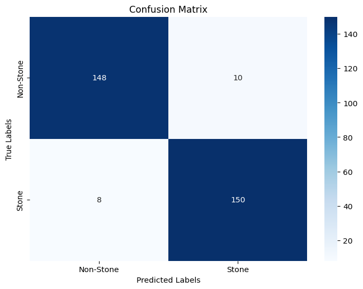
Kidney stone disease (nephrolithiasis) is a prevalent urological condition that is arguably the most prevalent one and also has a high burden of disease for the healthcare system. Even today, non-contrast computed tomography (NCCT) remains the gold standard imaging technique for stone detection, although the manual reading of computed tomography (CT) scans may be time-consuming and observer-dependent, especially for high-volume clinical practice. In this work, we develop an automated deep learning system for CT image detection of kidney stones from axial images. Two CNN-based systems were designed and tested: one with a specifically designed CNN architecture optimized for computation efficiency (cnnD) and another (cnnT) with a transfer learning approach using an architecture pre-trained on ImageNet. There were a total of 3,154 annotated CT images, which were used for training (2,522 images), validation (316 images), and testing (316 images). Pre-processing and normalization of standard images and data augmentation were used to enhance the model's robustness and generalisation. The custom CNN model's accuracy of 94.3%, precision of 0.95, recall of 0.94, and F1-score of 0.94 on the independent test set were validated in the experiment. Therefore, transfer learning for medical image analysis was demonstrated to be effective when the fine-tuned VGG16 model classified the images with a higher accuracy (96.5%). The custom CNN had less computation needed and also had quicker inference time as compared to VGG16, even though the latter achieved better predictive performance and thus could be applied in real clinical settings. The results suggest that the deep learning methods are useful for detecting kidney stones with high accuracy and efficiency from CT scans, and potentially for assisting radiologists in their clinical diagnosis and decisions. Overall, the proposed framework emphasizes the potential of using AI throughout the diagnostic process, and its goal is to improve the efficiency, uniformity, and accessibility of the diagnosis.
Downloads
References
1. K. Ahmed, M. K. Dubey, Kajal, S. Dubey, and D. K. Pandey, “Chronic kidney disease: causes, treatment, management, and future scope,” in Computational Intelligence for Genomics Data, Elsevier, 2025, pp. 99–111. https://doi.org/10.1016/B978-0-443-30080-6.00010-9.
2. K. J. Foreman et al., “Forecasting life expectancy, years of life lost, and all-cause and cause-specific mortality for 250 causes of death: reference and alternative scenarios for 2016–40 for 195 countries and territories,” The Lancet, vol. 392, no. 10159, pp. 2052–2090, Nov. 2018. https://doi.org/10.1016/S0140-6736(18)31694-5.
3. A. Caglayan, M. O. Horsanali, K. Kocadurdu, E. Ismailoglu, and S. Guneyli, “Deep learning model-assisted detection of kidney stones on computed tomography,” International Brazilian Journal of Urology, vol. 48, no. 5, pp. 830–839, Oct. 2022. https://doi.org/10.1590/s1677-5538.ibju.2022.0132.
4. W. Brisbane, M. R. Bailey, and M. D. Sorensen, “An overview of kidney stone imaging techniques,” Nature Reviews Urology, vol. 13, no. 11, pp. 654–662, Nov. 2016. https://doi.org/10.1038/nrurol.2016.154.
5. C. Türk et al., “EAU guidelines on diagnosis and conservative management of urolithiasis,” European Urology, vol. 69, no. 3, pp. 468–474, Mar. 2016. https://doi.org/10.1016/j.eururo.2015.07.040.
6. M. M. Ahsan et al., “Enhancing monkeypox diagnosis and explanation through modified transfer learning, vision transformers, and federated learning,” Information in Medicine Unlocked, vol. 45, 2024, Art. 101449. https://doi.org/10.1016/j.imu.2024.101449.
7. H. Xiang, M. Chan, V. Brown, Y. R. Huo, L. Chan, and L. Ridley, “Systematic review and meta-analysis of the diagnostic accuracy of low-dose computed tomography of the kidneys, ureters and bladder for urolithiasis,” Journal of Medical Imaging and Radiation Oncology, vol. 61, no. 5, pp. 582–590, Oct. 2017.
8. K. Viswanath, B. Anilkumar, and R. Gunasundari, “Design of deep learning reaction–diffusion level set segmentation approach for health care related to automatic kidney stone detection analysis,” Multimedia Tools and Applications, vol. 81, no. 29, pp. 41807–41849, Dec. 2022.
9. M. Baygin, O. Yaman, P. D. Barua, S. Dogan, T. Tuncer, and U. R. Acharya, “Exemplar Darknet19 feature generation technique for automated kidney stone detection with coronal CT images,” Artificial Intelligence in Medicine, vol. 127, 2022, Art. 102274.
10. S. U. R. Khan, M. N. Asim, S. Vollmer, and A. Dengel, “AI-driven diabetic retinopathy diagnosis enhancement through image processing and slap swarm algorithm-optimized ensemble network,” arXiv preprint arXiv:2503.14209, 2025.
11. H. Maqsood and S. U. R. Khan, “MeD-3D: a multimodal deep learning framework for precise recurrence prediction in clear cell renal cell carcinoma,” arXiv preprint arXiv:2507.07839, 2025.
12. A. Hekmat, Z. Zuping, O. Bilal, and S. U. R. Khan, “Differential evolution-driven optimized ensemble network for brain tumor detection,” International Journal of Machine Learning and Cybernetics, vol. 16, no. 9, pp. 6447–6472, Sep. 2025.
13. M. Shetty, S. B. Shetty, G. P. Sequeria, and V. Hegde, “Kidney stone detection using CNN,” in Proceedings of the 2024 International Conference on Data Science and Information System (ICDSIS), IEEE, 2024, pp. 1–6.
14. W. Pree Danan et al., “Improvement of urinary stone segmentation using GAN-based urinary stones inpainting augmentation,” IEEE Access, vol. 10, pp. 115131–115142, 2022.
15. M. N. Islam et al., “Vision transformer and explainable transfer learning models for auto detection of kidney cyst, stone and tumor from CT-radiography,” Scientific Reports, vol. 12, no. 1, Art. 11440, Jul. 2022.
16. D. C. Elton, E. B. Turkbey, P. J. Pickhardt, and R. M. Summers, “A deep learning system for automated kidney stone detection and volumetric segmentation on noncontract CT scans,” Medical Physics, vol. 49, no. 4, pp. 2545–2554, Apr. 2022.
17. A. Khan, R. Das, and M. C. Parameshwara, “Detection of kidney stone using digital image processing: a holistic approach,” Engineering Research Express, vol. 4, no. 3, Art. 035040, Sep. 2022.
18. Y. Cui et al., “Automatic detection and scoring of kidney stones on noncontract CT images using S.T.O.N.E. nephrolithometry: combined deep learning and thresholding methods,” Molecular Imaging and Biology, vol. 23, no. 3, pp. 436–445, Jun. 2021.
19. S. U. Rehman Khan et al., “ShallowMRI: a novel lightweight CNN with novel attention mechanism for multi brain tumor classification in MRI images,” Biomedical Signal Processing and Control, vol. 111, Art. 108425, Jan. 2026.
20. O. Bilal, A. Hekmat, and S. U. R. Khan, “Automated cervical cancer cell diagnosis via grid search-optimized multi-CNN ensemble networks,” Network Modeling Analysis in Health Informatics and Bioinformatics, vol. 14, no. 1, p. 67, Jul. 2025.
21. M. M. Hossain et al., “A novel hybrid ViT-LSTM model with explainable AI for brain stroke detection and classification in CT images,” Computers in Biology and Medicine, vol. 186, Art. 109711, Mar. 2025.
22. T. Diwan, G. Anirudh, and J. V. Tembhurne, “Object detection using YOLO: challenges, architectural successors, datasets and applications,” Multimedia Tools and Applications, vol. 82, no. 6, pp. 9243–9275, Mar. 2023.
23. [23] K. He, X. Zhang, S. Ren, and J. Sun, “Deep residual learning for image recognition,” in Proceedings of the IEEE Conference on Computer Vision and Pattern Recognition (CVPR), 2016, pp. 770–778.
24. Ultralytics, “Revolutionizing the world of vision AI.” [Online]. Available: https://www.ultralytics.com/ (Accessed Jul. 28, 2025).
25. L. A. Fitri et al., “Automated classification of urinary stones based on microcomputed tomography images using convolutional neural network,” Physica Medica, vol. 78, pp. 201–208, Oct. 2020.
26. M. Gulhane et al., “Integrative approach for efficient detection of kidney stones based on improved deep neural network architecture,” SLAS Technology, vol. 29, no. 4, Art. 100159, Aug. 2024.
27. M. M. Ahmed et al., “Brain tumor detection and classification in MRI using hybrid ViT and GRU model with explainable AI,” Scientific Reports, vol. 14, no. 1, Art. 22797, Oct. 2024.
28. M. M. Hossain et al., “cardiovascular disease identification using a hybrid CNN-LSTM model with explainable AI,” Information in Medicine Unlocked, vol. 42, Art. 101370, 20
Downloads
Published
Issue
Section
Categories
License
Copyright (c) 2026 Amjad khan, Muhammad Javed, Nasir Gul, Saif Ullah Noor, Reyan, Ashraf Ullah (Author)

This work is licensed under a Creative Commons Attribution 4.0 International License.
How to Cite