A Multi-Dimensional Quantitative Framework for Responsible AI Governance Evaluation in Facial Recognition Attendance Systems
DOI:
https://doi.org/10.71146/kjmr951Keywords:
Facial Recognition System,, Rubric-Based Assessment, Responsible AI (RAI), Quantitative EvaluationAbstract
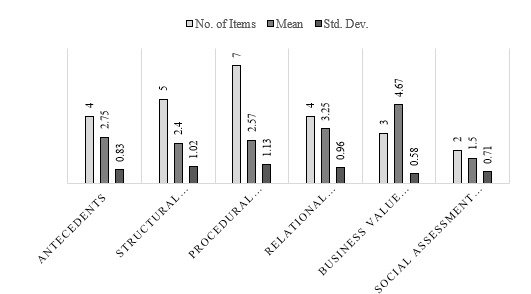
The issue of responsible artificial intelligence (AI) governance has gained increased relevance over time. Organizational decision-making processes have a significantly considered and embedded such a procedures in their conventional methods of evolution. Although many empirical studies have suggested conceptual models of responsible AI governance, however, quantitative validation is still subdued. Therefore, in this study an attempt is made to operationalize the AI governance systems into a quantitative evaluation rubric for a real case. Using a quantitative case study approach, an attendance system based on facial recognition at a university was measured using six dimensions of governance, such as Antecedents, Structural Practices, Procedural Practices, Relational Practices, Business Value Effects and Social Assessment Effects. The findings reveal a strong operational efficiency and business value creation, respectively. Study also proves a positive impact of the adoption of structural and procedural governance processes, especially in the field of ethics supervision and the reduction of bias. The internal consistency of the proposed rubric is established by reliability analysis.
Downloads
References
[1] E. Papagiannidis, P. Mikalef, and K. Con-boy, “Responsible artificial intelligence governance: A review and research frame-work,” Journal of Strategic Information Systems, vol. 34, no. 1, p. 101885, 2025, doi: 10.1016/j.jsis.2024.101885.
[2] R. Schneider et al., “Artificial intelligence governance for businesses,” Journal of In-formation Technology Case and Application Research, vol. 25, no. 1, pp. 1–18, 2023, doi: 10.1080/10580530.2022.2085825.
[3] K. Martin and A. Waldman, “Are algorithmic decisions legitimate? The effect of process and outcomes on perceptions of legitimacy of AI decisions,” Journal of Business Ethics, vol. 174, pp. 1–17, 2023, doi: 10.1007/s10551-
021-05032-7.
[4] M. Floridi et al., “Ethics-based auditing to develop trustworthy AI,” Minds and Ma-chines, vol. 31, pp. 491–510, 2021, doi: 10.1007/s11023-021-09557-8.
[5] I. Minkkinen et al., “What about investors? ESG analyses as tools for ethics-based AI auditing,” AI & Society, 2024, doi: 10.1007/s00146-022-01415-0.
[6] I. Janssen et al., “Toward AI governance: Identifying best practices, barriers, and out-comes,” Information Systems Frontiers, vol. 25, pp. 1–18, 2023, doi: 10.1007/s10796-022-
10251-y.
[7] M. M¨antym¨aki et al., “Defining organizational AI governance,” AI and Ethics, vol. 2, pp. 1–14, 2022, doi: 10.1007/s43681-022-
00143-x.
[8] E. Papagiannidis et al., “Thinking responsibly about responsible AI and the ‘dark side’ of AI,” European Journal of Information Systems, vol. 31, no. 3, pp. 257–270, 2022, doi: 10.1080/0960085X.2022.2026621.
[9] I. Mikalef et al., “Artificial intelligence capability: Conceptualization, measurement calibration, and impact on organizational creativity and firm performance,” Information & Management, vol. 58, no. 3, p. 103434,
2021, doi: 10.1016/j.im.2021.103434.
[10] P. G. R. de Almeida, C. D. dos Santos, and J.
S. Farias, “Artificial intelligence regulation: A framework for governance,” Ethics and Information Technology, vol. 23, pp. 505–525, 2021, doi: 10.1007/s10676-021-09593-z.
[11] R. Abraham, J. Schneider, and J. vom Brocke, “Data governance: A conceptual framework, structured review, and research agenda,” International Journal of Information Management, vol. 49, pp. 424–438, 2019, doi: 10.1016/j.ijinfomgt.2019.07.008.
[12] A. Adadi and M. Berrada, “Peeking inside the black-box: A survey on explainable arti-ficial intelligence (XAI),” IEEE Access, vol. 6, pp. 52138–52160, 2018, doi: 10.1109/AC-CESS.2018.2870052.
[13] A. Ahmad et al., “How can organizations develop situation awareness for incident response: A case study,” Computers & Security, vol. 101, p. 102122, 2021, doi: 10.1016/j.cose.2020.102122.
[14] S. Akter et al., “Algorithmic bias in data-driven innovation in the age of AI,” International Journal of Information Management, vol. 60, p. 102387, 2021, doi: 10.1016/j.ijinfomgt.2021.102387.
[15] R. Clarke, “Principles and business processes for responsible AI,” Computer Law & Security Review, vol. 35, pp. 410–422, 2019, doi: 10.1016/j.clsr.2019.04.007.
[16] U. Gasser and V. A. F. Almeida, “A layered model for AI governance,” IEEE Internet Computing, vol. 21, no. 6, pp. 58–62, 2017, doi: 10.1109/MIC.2017.4180835.
[17] L. Floridi and J. Cowls, “A unified framework of five principles for AI in society,” in Ethics, Governance, and Policies in Artificial Intelligence, Springer, 2021, pp. 5–17, doi: 10.1007/978-3-030-81907-1 2.
[18] V. Dignum, Responsible Artificial Intelligence: How to Develop and Use AI in a Responsible Way, Springer, 2019, doi: 10.1007/978-3-030-30371-6.
[19] V. Mercha´n-Rodr´ıguez and C. Juiz, “Governance of Technologies and Information Systems for the Higher Education: System-atic Mapping of Study,” Journal of Computer Science & Technology, vol. 24, arti-cle e05, 2024. doi: https://doi.org/10. 24215/16666038.24.e05
[20] M. C. Pezzini and C. Pons, “Explainable Artificial Intelligence: Analysis of Methodologies and Applications,” Journal of Computer Science & Technology, vol. 25, e07, 2025. doi: 10.24215/16666038.25.e07.
[21] J. DAlotto, C. Pons, and L. Antonelli, “Artificial Intelligence Applied in Legal In-formation: A Systematic Mapping Study,” Journal of Computer Science & Technology, vol. 25, e03, 2025. doi: https://doi.org/
Downloads
Published
Issue
Section
Categories
License
Copyright (c) 2026 Mumtaz Ali, Hamid Ali, Muhammad Naeem, Syed Hashir Ali (Author)

This work is licensed under a Creative Commons Attribution 4.0 International License.
How to Cite