THE IMPACTS OF COVID-19 ON THE TOURISM SECTOR: A STUDY ON ACCELERATED DIGITALIZATION AND CRISIS MANAGEMENT
DOI:
https://doi.org/10.71146/kjmr947Keywords:
COVID-19, tourism sector, digitalization, crisis management, organizational resilience, digital transformation, tourism recovery, smart tourism, business continuity, sustainable tourismAbstract
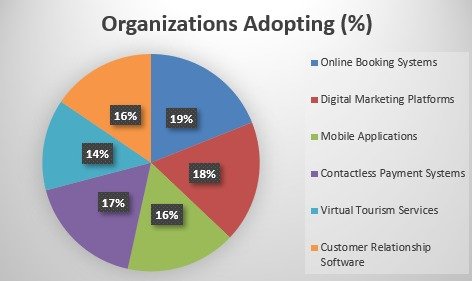
COVID-19 has made the global tourism industry face unprecedented challenges, with the number of tourists, business revenue, jobs lost, and the impact on the operational performance plummeting. This study explores COVID-19's effects on the tourism sector, focusing on the accelerated digitalisation and crisis handling processes. A quantitative research methodology was chosen and data were analyzed from a sample of 250 respondents from hotel firms, travel agencies, tour operators and hospitality firms. Descriptive statistics, correlation analysis, and regression analysis were employed to analyse the relationship between digital transformation, the effectiveness of crisis management and organizational resilience. The results showed that the pandemic period had a significant impact on the decrease in tourist numbers by 72%, the decrease in tourist bookings by 78% and the decrease in business revenue by 69%. As a result of these disturbances, 88% of organizations started using online booking systems, 84% started using digital marketing platforms and 81% started using contactless payment technologies. The study also revealed that organizations that are highly digitalized were able to recover 81% of their revenue, whereas those organizations that are less digitalized were able to recover 52% of their revenue. Digitalization and organizational resilience were found to be positively correlated with each other, with a strong positive correlation (r = 0.84). Other recovery-related performance components, such as crisis management, including health and safety measures, digital customer engagement, and business continuity planning, also had a significant impact. The study has found that accelerated digitalization was a key enabler for the tourism organizations in coping with the COVID-19 crisis and the process of recovery afterwards. The results call for the adoption of digital transformation and strategic crisis management in the tourism development policies to enhance tourism resilience, competitiveness and sustainability in the international tourism.
Downloads
References
1. Brozović, D., & Saito, H. (2022). The impacts of Covid-19 on the tourism sector: Changes, adaptations and challenges. Tourism: An International Interdisciplinary Journal, 70(3), 465-479.
2. Rahman, M. K., Sifa, R., & Hassan, A. (2022). COVID-19 effects on tourism events, technology acceleration and future research directions. In Digital Transformation and Innovation in Tourism Events (pp. 213-223). Routledge.
3. Giannoukou, I., & Kougia, A. (2024, September). Innovative digital strategies in crisis management for tourism enterprises: Enhancing resilience and sustainable growth in the digital era. In International Conference of the International Association of Cultural and Digital Tourism (pp. 47-87). Cham: Springer Nature Switzerland.
4. Gurbanov, N., Yagublu, N., Akbarli, N., & Niftiyev, I. (2022). Digitalization and the Covid-19-led public crisis management: An evaluation of financial sustainability in the Azerbaijan business sector. SocioEconomic Challenges, 6(3), 23-38.
5. Mehmood, S., Nazir, S., & Junxia, L. (2025). Tourism Crisis Management: A Strategic Analysis of the Hospitality Industry's Resilience in Response to Global Pandemics and Natural Disasters. Journal of Contingencies and Crisis Management, 33(4), e70101.
6. Kovač, A. (2024). Milestone of Croatian tourism: Covid-19 pandemic as cause of accelerated digitalization and tourism growth (Doctoral dissertation, Sveučilište u Zagrebu, Sveučilište u Zagrebu Ekonomski fakultet).
7. Zhu, J., Zhang, H., & Feng, W. (2022). Enterprise Operational Resilience With Digitalization Approach Amid the COVID‐19 Era: An Empirical Assessment. Journal of Environmental and Public Health, 2022(1), 6274670.
8. Scarlat, C., Stănciulescu, G. D., & Panduru, D. A. (2022). COVID-19 pandemic as accelerator: opportunity for digital acceleration. Journal of Internet and e-Business Studies, 2022, 1-14.
9. Okafor, L., Khalid, U., & Gama, L. E. M. (2023). Do the size of the tourism sector and level of digitalization affect COVID-19 economic policy response? Evidence from developed and developing countries. Current Issues in Tourism, 26(18), 3040-3063.
10. Li, Z., Wang, D., Abbas, J., Hassan, S., & Mubeen, R. (2022). Tourists’ health risk threats amid COVID-19 era: role of technology innovation, Transformation, and recovery implications for sustainable tourism. Frontiers in Psychology, 12, 769175.
11. Mele, C., Russo-Spena, T., Corsaro, D., & Kleinaltenkamp, M. (2022). Guest editorial: Crisis management in the COVID-19 pandemic waves. Journal of Business & Industrial Marketing, 37(10), 1949-1958.
12. Kahveci, E., Avunduk, Z. B., Daim, T., & Zaim, S. (2025). The role of flexibility, digitalization, and crisis response strategy for SMEs: Case of COVID-19. Journal of Small Business Management, 63(3), 1198-1235.
13. Kronblad, C., & Envall Pregmark, J. (2024). Responding to the COVID-19 crisis: the rapid turn toward digital business models. Journal of Science and Technology Policy Management, 15(3), 451-467.
14. Kuščer, K., Eichelberger, S., & Peters, M. (2022). Tourism organizations’ responses to the COVID-19 pandemic: An investigation of the lockdown period. Current Issues in Tourism, 25(2), 247-260.
15. Drammeh, F. Y. (2024). Managing tourism during the COVID-19 pandemic. A systematic review of crisis management in the tourism industry. Cogent Social Sciences, 10(1), 2311955.
16. Elkhwesky, Z., El Manzani, Y., & Elbayoumi Salem, I. (2024). Driving hospitality and tourism to foster sustainable innovation: A systematic review of COVID-19-related studies and practical implications in the digital era. Tourism and Hospitality Research, 24(1), 115-133.
17. Mirčetić, V., & Mihić, M. (2022, June). Smart Tourism as a Strategic Response to Challenges of Tourism in the Post-COVID Era. In International Symposium SymOrg (pp. 445-463). Cham: Springer International Publishing.
18. Matijević, J., Zielinski, S., & Ahn, Y. J. (2025). Exploring the impact of COVID-19 recovery strategies in the hospitality and tourism industry. Administrative Sciences, 15(4), 142.
19. Liu, L., Wu, D., & Peng, N. (2025). The impact of COVID-19 and digital transformation on stock price volatility from the perspective of cultural and tourism industries. International Review of Economics & Finance, 101, 104144.
20. Ndou, V., Mele, G., Hysa, E., & Manta, O. (2022). Exploiting technology to deal with the COVID-19 challenges in travel & tourism: A bibliometric analysis. Sustainability, 14(10), 5917.
Downloads
Published
Issue
Section
Categories
License
Copyright (c) 2026 Muhammad Usman Shoukat (Author)

This work is licensed under a Creative Commons Attribution 4.0 International License.
How to Cite