IDENTIFYING THE OPTIMUM NITROGEN RATE FOR MAXIMIZING WINTER WHEAT YIELD AND NITROGEN USE EFFICIENCY IN JIANGSU, CHINA
DOI:
https://doi.org/10.71146/kjmr946Keywords:
winter Wheat, Nitrogen application, Yield response, Growth parameters, Grain yield, Spike density, Agronomic traits, Nitrogen use efficiency, Cropland management, Fertilizer optimizationAbstract
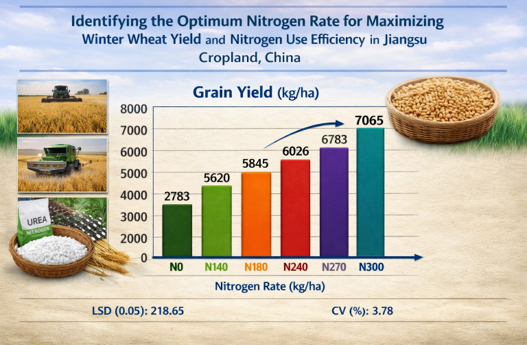
A field study was conducted to evaluate the response of winter wheat growth and yield attributes to different nitrogen application rates under cropland conditions. Treatments consisted of increasing nitrogen levels from N0 to N300 kg ha⁻¹. Results showed that all measured agronomic traits were significantly influenced by nitrogen application. Plant height, leaf length, and spike length increased progressively with higher nitrogen rates, with maximum values recorded at N300kg ha⁻¹ (76 cm, 26 cm, and 8.3 cm, respectively), indicating enhanced vegetative growth under sufficient nitrogen supply. Yield components also improved significantly with nitrogen fertilization. Grains per spike increased from 38 in the control to 54 under N300kg ha⁻¹, while spikes per square meter more than doubled from 140 to 294, demonstrating improved tillering and reproductive development. Thousand-grain weight showed relatively limited variation but still increased slightly with nitrogen application, reaching a maximum of 50.55 g. Grain yield exhibited a strong response to nitrogen, rising from 2783.20 kg ha⁻¹ in the control to 7064.58 kg ha⁻¹ under N300kg ha⁻¹. However, yield gains began to plateau beyond N240-N300kg ha⁻¹, indicating diminishing returns at higher nitrogen levels. Although N300kg ha⁻¹ produced the highest yield, differences among the highest nitrogen treatments were minimal, suggesting an optimal response range between N270 and N300kg ha⁻¹ under the conditions studied. Overall, nitrogen application significantly enhanced winter wheat growth and productivity, primarily by improving vegetative growth, spike density, and grain number. However, the observed plateau at higher nitrogen rates highlights the need for optimized nitrogen management to maximize yield efficiency while avoiding unnecessary fertilizer inputs.
Downloads
References
Addy J. W. G., Ellis R. H., Macdonald A. J., Semenov M. A., Mead A. (2020). Investigating the effects of inter-annual weather variation (1968–2016) on the functional response of cereal grain yield to applied nitrogen, using data from the Rothamsted long-term experiments. Agric. For. Meteorol. 284:107898. 10.1016.
Ahmed, S., Kaleri, A. A., Manzoor, D., Khushk, G. M., Solangi, M. H., Khaskheli, W. A., Gadahi, A, R., Laghari, R., & Pathan, N. F. (2023). Effect of different irrigation water regimes on water productivity of wheat crops. Pure and Applied Biology, 12(3), 1479-1489.
Bai, H., Wang, J., Fang, Q. and Huang, B. (2020). Does a trade-off between yield and efficiency reduce water and nitrogen inputs of winter wheat in the North China Plain?. Agricultural water management, 233, p.106095.
Carrijo, D.R.; Lundy, M.E.; Linquist, B.A. (2017). Rice Yields and Water Use under Alternate Wetting and Drying Irrigation: A Meta-Analysis. Field Crop. Res. , 203, 173–180.
Cossani C. M., Sadras V. O. (2018). Water-nitrogen colimitation in grain crops. Adv. Agron. 150 231–274.
De Oliveira Silva, A., Ciampitti, I.A., Slafer, G.A. and Lollato, R.P. (2020). Nitrogen utilization efficiency in wheat: A global perspective. European Journal of Agronomy, 114, p.126008.
Deng, L., Zhang, H., Wang, C., Ma, W., Zhu, A., Zhang, F. and Jiao, X.S(2021). Improving the sustainability of the wheat supply chain through multi-stakeholder engagement. Journal of cleaner production, 321, p.128837.
Duncan, E.G., O’Sullivan, C.A., Roper, M.M., Biggs, J.S. and Peoples, M.B. (2018). Influence of co-application of nitrogen with phosphorus, potassium and Sulphur on the apparent efficiency of nitrogen fertilizer use, grain yield and protein content of wheat. Field crops research, 226, pp.56-65.
Fan Y., Wang C., Nan Z. (2018). Determining water use efficiency of wheat and cotton: a meta-regression analysis. Agric. Water Manag. 199 48–60.
Gadahi, R, A., Laghari, M, G., Kaleri, A, A., Manzoor, D., Afzal, A., Mahar, R, A., Jan, A., Khan, S., Soomro, A, M., Ullah, S., Sodhro, A, A., Kaleri, A, A. (2024). Effect of different weed management practices on growth and yield of wheat (Triticum aestivum L.). Pure and Applied Biology,14(2),297-303.
Kaleri, A, A., Khushk, M, G., Jogi, Q., Lund, M, M., Magsi, H, M., Baloch, N., Manzoor, D., Magsi, A, M., Awan, H, M., Kaleri, S, G., Rajput, A, A., Pathan, F, N., Laghari, R. (2023). Response of Wheat Crop to Various Foliar Applications of Nitrogen, Zinc and Boron Fertilizers. Response of wheat crop to various foliar applications of nitrogen, zinc, and boron fertilizers. Plant Health, 02(02), 51-55.
Kaleri, A, A., Lund, M, M., Manzoor, D. Din, U, Z., Faizan, M., Azhar, A., Shah, H, T., Solangi, S., Bukhsh, K, K., Rajput, A, W., Kaleri, S, G. (2024). Comprehensive Evaluation of the Various Effects of Fertilization With Potassium, Zinc, and Boron on Wheat Growth and Yield Performance. International Journal of Biology and Biotechnology, 21(4), 597-603.
Kubar, S, M., Kaleri, A, A., Manzoor, D., Rehmani, U., Rehman, U, S., Baksh, W., Munir, H., Laghari, R., Meghwar, R, V., Bazai, K, L, M., Wude, Y. (2025). Impact Of Nitrogen Fertilizer Management on Distribution of Nitrogen Content in Different Organs of Winter Wheat. Kashf Journal of Multidisciplinary Research, 02(1), 45-58.
Li, Z., Cui, S., Zhang, Q., Xu, G., Feng, Q., Chen, C. and Li, Y. (2022). Optimizing wheat yield, water, and nitrogen use efficiency with water and nitrogen inputs in China: A synthesis and life cycle assessment. Frontiers in Plant Science, 13, p.930484.
Li, Z., Zhang, Q., Wei, W., Cui, S., Tang, W. and Li, Y. (2020). Determining effects of water and nitrogen inputs on wheat yield and water productivity and nitrogen use efficiency in China: A quantitative synthesis. Agricultural Water Management, 242, p.106397.
Liu, X.; Xu, S.; Zhang, J.; Ding, Y.; Li, G.; Wang, S.; Liu, Z.; Tang, S.; Ding, C.; Chen, L. (2016). Effect of Continuous Reduction of Nitrogen Application to a Rice-Wheat Rotation System in the Middle-Lower Yangtze River Region (2013–2015). Field Crop. Res., 196, 348–356.
Ma, W.; Li, J.; Ma, L.; Wang, F.; Sisák, I.; Cushman, G.; Zhang, F. (2008). Nitrogen Flow and Use Efficiency in Production and Utilization of Wheat, Rice, and Maize in China. Agric. Syst., 99, 53–63.
Man, J., Wang, D., White, P.J. and Yu, Z. (2014). The length of micro-sprinkling hoses delivering supplemental irrigation affects photosynthesis and dry matter production of winter wheat. Field Crops Research, 168, pp.65-74.
Manzoor, D., Kaleri, A. A., Rajput, A. A., Fida, T., Kakar, N., Shakoor, A., Javed, U, M., Rasool, W, M., Javed, A, M., Ashraf, A., Buriro, A, N., Rajput, U, M. (2024). Enhancing Wheat (Triticum aestivum L.) Growth through Farmyard Manure Application of Potassium Fertilizer. Journal of Agriculture and Veterinary Sciences. 03(1), 21-32.
Memon, A., Soomro, N.S., Soomro, F.D., Kaleri, A.A., Talpur, J.T., Khan, H., Soomro, G. and Soomro, M.H. (2025). Impact of boron levels on the growth and yield of wheat (TriticumaestivumL.). Insights Journal of Life and Social Sciences, 3(2), pp.170-175.
Meng, Q.; Yue, S.; Chen, X.; Cui, Z.; Ye, Y.; Ma, W.; Tong, Y.; Zhang, F. (2013). Understanding dry matter and nitrogen accumulation with time-course for high-yielding wheat production in China. PLoS ONE, 8, e68783.
Mustafa G., Mahmood H., Iqbal A. (2021). Environmentally friendly farming and yield of wheat crop: a case of developing country. J. Clean. Prod. 314:127978.
Nadeem, M.Y., Zhang, J., Zhou, Y., Ahmad, S., Ding, Y. and Li, G. (2022). Quantifying the impact of reduced nitrogen rates on grain yield and nitrogen use efficiency in the wheat and rice rotation system of the Yangtze river region. Agronomy, 12(4), p.920.
Naqeebullah, Manzoor, D., Kaleri, A, A., Kakar, K., Sadiqa, A., Islam, M., Musawwir, A., Ullah, Z., Jamali, A., Sadiq, M., Adil, S. (2024). Effects of Phosphorus Application Rate on the Growth and Yield of Wheat (Triticum aestivum L.). Pak-Euro Journal of Medical and Life Sciences, 7(2), 151-158.
Shar, A, P., Soomro, A, A., Kaleri, A, A., Soomro, D, F., Naz, N., Zarnaz., Jamali, H, K., Mastoi, H, A., Tahir, Y, M., Mirbahar, H, S. (2025). Characterizing Drought Tolerance in Wheat Genotypes for Yield Associated Traits Under Different Water Stress Conditions. Journal of Agriculture and Biology, 3(1), 219-230.
Terrile, I.I.; Miralles, D.J.; González, F.G. (2017). Fruiting efficiency in wheat (Triticum aestivum L): Trait response to different growing conditions and its relation to spike dry weight at anthesis and grain weight at harvest. Field Crops Res., 201, 86–96.
Umrani, H, J., Kaleri, A, A., Manzoor, D., Buriro, A, N., Khan, Z, S., Munir, H., Jiskani, M, W., Fazal, S., Rehmani, U., Ashfaq, L. (2024). Performance of Various Wheat (Triticum aestivum L.) Cultivars under Salinity Stress. Journal of life Sciences (LGU),8(04), 537-550.
Yang, D.; Cai, T.; Luo, Y.; Wang, Z. (2019). Optimizing plant density and nitrogen application to manipulate tiller growth and increase grain yield and nitrogen-use efficiency in winter wheat. PeerJ, 7, e6484.
Zhang, J.; Dong, S.; Dai, X.; Wu, T.; Wang, X.; Bai, H.; Wang, L.; He, M.(2016) Combined effect of plant density and nitrogen input on grain yield, nitrogen uptake and utilization of winter wheat. Vegetos-Int. J. Plant Res., 29, 63–73.
Zhang, Z., Zhang, Y., Shi, Y. and Yu, Z. (2020). Optimized split nitrogen fertilizer increase photosynthesis, grain yield, nitrogen use efficiency and water use efficiency under water-saving irrigation. Scientific Reports, 10(1), p.20310.
Zhao H., Zhai X., Guo L., Liu K., Huang D., Yang Y., et al. (2019). Assessing the efficiency and sustainability of wheat production systems in different climate zones in China using energy analysis. J. Clean. Prod. 235 724–732.
Downloads
Published
License
Copyright (c) 2026 Danish Manzoor, Shujie Miao, Urooj Rehmani, Zaheer Ud Din, Muhammad Ali Khan, Syed Naimat Hussain, Abdul Rab Naich (Author)

This work is licensed under a Creative Commons Attribution 4.0 International License.
How to Cite