PREVALENCE AND QUANTIFICATION OF MICROPLASTICS IN BOTTLED WATER
DOI:
https://doi.org/10.71146/kjmr925Keywords:
Microplastics, Bottled water, ATR-FTIR, ImageJ, Polyethylene, Polypropylene, water contaminationAbstract
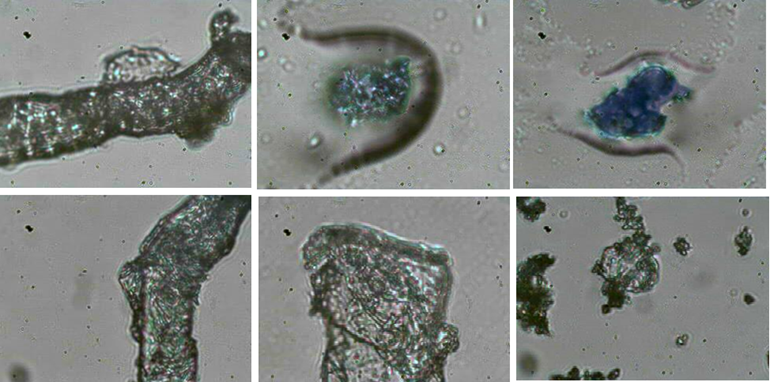
Plastics are commonplace contaminants that we utilize on a daily basis. Microplastics (small particles less than five millimeters in size) are being found in water systems and could pose a threat to human health via routes such as bottled water. This study aims to identify and quantify microplastics in drinking water that is sold in bottles. An Olympus BX51 microscope was used to check the microplastic after separation on filter and staining with methylene blue and total number counted by using ImageJ software. Microplastic separated and stained were found in the range between 22-246/L. the particles stained on filter paper were further analyzed by using ATR-FTIR spectroscopy to check the nature of particles and compared it against the standard spectra of most commonly found popular plastics like polyethylene (PE) and polypropylene (PP). polyethylene (PE) was found to be mostly occurring micro contaminates in water system. The findings imply that bottled water contains microplastics, which may pose risks to human health. This necessitates further investigation into the sources and effects of microplastic contamination.
Downloads
References
Allen, S., Allen, D., Phoenix, V. R., Le Roux, G., Durántez Jiménez, P., Simonneau, A., . . . Galop, D. (2019). Atmospheric transport and deposition of microplastics in a remote mountain catchment. Nature geoscience, 12(5), 339–344.
Andrady, A. L. (2011). Microplastics in the marine environment. Marine pollution bulletin, 62(8), 1596–1605.
Bakir, A., Rowland, S. J., & Thompson, R. C. (2014). Transport of persistent organic pollutants by microplastics in estuarine conditions. Estuarine, Coastal and Shelf Science, 140, 14–21.
Chen, G., Feng, Q., & Wang, J. (2020). Mini-review of microplastics in the atmosphere and their risks to humans. Science of the Total Environment, 703, 135504.
Cole, M., Lindeque, P., Halsband, C., & Galloway, T. S. (2011). Microplastics as contaminants in the marine environment: a review. Marine pollution bulletin, 62(12), 2588–2597.
Dris, R., Gasperi, J., Rocher, V., Saad, M., Renault, N., & Tassin, B. (2015). Microplastic contamination in an urban area: a case study in Greater Paris. Environmental Chemistry, 12(5), 592–599.
Geyer, R., Jambeck, J. R., & Law, K. L. (2017). Production, use, and fate of all plastics ever made. Sci Adv 3: e1700782. In.
Haider, T. P., Völker, C., Kramm, J., Landfester, K., & Wurm, F. R. (2019). Plastics of the future? The impact of biodegradable polymers on the environment and on society. Angewandte Chemie International Edition, 58(1), 50–62.
Hernandez, L. M., Xu, E. G., Larsson, H. C., Tahara, R., Maisuria, V. B., & Tufenkji, N. (2019). Plastic teabags release billions of microparticles and nanoparticles into tea. Environmental science & technology, 53(21), 12300–12310.
Hidalgo-Ruz, V., Gutow, L., Thompson, R. C., & Thiel, M. (2012). Microplastics in the marine environment: a review of the methods used for identification and quantification. Environmental science & technology, 46(6), 3060–3075.
Horton, A. A., & Dixon, S. J. (2018). Microplastics: An introduction to environmental transport processes. Wiley Interdisciplinary Reviews: Water, 5(2), e1268.
Jambeck, J. R., Geyer, R., Wilcox, C., Siegler, T. R., Perryman, M., Andrady, A., . . . Law, K. L. (2015). Plastic waste inputs from land into the ocean. Science, 347(6223), 768–771.
Kosuth, M., Mason, S. A., & Wattenberg, E. V. (2018). Anthropogenic contamination of tap water, beer, and sea salt. Plos one, 13(4), e0194970.
Lambert, S., & Wagner, M. (2017). Microplastics are contaminants of emerging concern in freshwater environments: an overview. Freshwater microplastics: emerging environmental contaminants?, 1–23.
Löder, M. G., & Gerdts, G. (2015). Methodology used for the detection and identification of microplastics—a critical appraisal. Marine anthropogenic litter, 201–227.
Mason, S. A., Welch, V. G., & Neratko, J. (2018). Synthetic polymer contamination in bottled water. Frontiers in chemistry, 6, 389699.
Mintenig, S. M., Int-Veen, I., Löder, M. G., Primpke, S., & Gerdts, G. (2017). Identification of microplastic in effluents of waste water treatment plants using focal plane array-based micro-Fourier-transform infrared imaging. Water research, 108, 365–372.
Rochman, C. M., Hoh, E., Kurobe, T., & Teh, S. J. (2013). Ingested plastic transfers hazardous chemicals to fish and induces hepatic stress. Scientific Reports, 3(1), 3263.
Schneider, C. A., Rasband, W. S., & Eliceiri, K. W. (2012). NIH Image to ImageJ: 25 years of image analysis. Nature methods, 9(7), 671–675.
Schymanski, D., Goldbeck, C., Humpf, H.-U., & Fürst, P. (2018). Analysis of microplastics in water by micro-Raman spectroscopy: Release of plastic particles from different packaging into mineral water. Water research, 129, 154–162.
Shim, W., Hong, S., & Eo, S. (2017). Identification methods in microplastic analysis: a review. Anal Methods 9: 1384–1391. In.
Tinel, L., Constant, M., Dackane, C., Hammond, V., Billon, G., & Alary, C. (2025). Microplastics as contaminants in the marine environment: A review. Paper presented at the Rencontres 2025 du GDR Plastiques Environnement Santé.
Vázquez-Rowe, I., Ita-Nagy, D., & Kahhat, R. (2021). Microplastics in fisheries and aquaculture: Implications to food sustainability and safety. Current Opinion in Green and Sustainable Chemistry, 29, 100464.
Yadav, M., Negi, V., & Verma, H. (2024). Impact of synthetic microfibers and their toxicity on the environment. In Sustainable Microbial Technology for Synthetic and Cellulosic Microfiber Bioremediation (pp. 123–156): Springer.
Downloads
Published
License
Copyright (c) 2026 Zahid H Shar, Anoosha Maryam, Nusrat N Memon, Muqadus Abbasi, Pawan Kumar, Pirah Ismail, Pirah Zahir (Author)

This work is licensed under a Creative Commons Attribution 4.0 International License.
How to Cite