COMPARATIVE ANALYSIS OF MACHINE LEARNING MODELS FOR LEGAL CASE PREDICTION
DOI:
https://doi.org/10.71146/kjmr920Keywords:
legal case, machine learning, analysisAbstract
Predicting legal case outcomes is a complex task due to the influence of multiple interrelated factors, including financial conditions, institutional characteristics, and legal dynamics. With the increasing availability of structured legal data, machine learning techniques provide an effective approach for supporting data-driven decision-making in this domain.
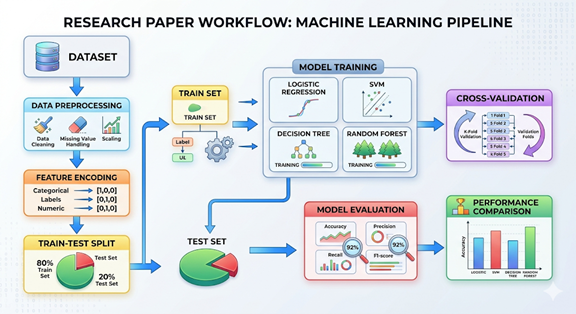
This study evaluates the performance of four machine learning models—Logistic Regression, Support Vector Machine, Decision Tree, and Random Forest—for predicting legal case outcomes. The dataset consists of structured features such as liability scores, financial indicators, and organizational attributes. Data preprocessing techniques, including handling missing values, feature selection, and one-hot encoding, were applied to prepare the dataset. The data was split using stratified sampling, and model performance was validated through 5-fold cross-validation.
The models were evaluated using accuracy, precision, recall, and F1-score. Results indicate that Random Forest achieved the best overall performance, while Logistic Regression showed comparatively lower effectiveness. The findings highlight the importance of model selection and demonstrate the effectiveness of ensemble methods for structured legal data prediction.
Downloads
References
Aletras, N., Tsarapatsanis, D., Preoțiuc-Pietro, D., & Lampos, V. (2016). Predicting judicial decisions of the European Court of Human Rights: A natural language processing perspective. PeerJ Computer Science, 2, e93. https://doi.org/10.7717/peerj-cs.93
Katz, D. M., Bommarito, M. J., & Blackman, J. (2017). A general approach for predicting the behavior of the Supreme Court of the United States. PLOS ONE, 12(4), e0174698. https://doi.org/10.1371/journal.pone.0174698
Chen, T., & Guestrin, C. (2016). XGBoost: A scalable tree boosting system. In Proceedings of the 22nd ACM SIGKDD International Conference on Knowledge Discovery and Data Mining (pp. 785–794). https://doi.org/10.1145/2939672.2939785
Liu, Z., & Chen, H. (2017). A predictive performance comparison of machine learning models for judicial cases. In Proceedings of the 2017 IEEE Symposium Series on Computational Intelligence (SSCI). https://doi.org/10.1109/SSCI.2017.8285436
Chalkidis, I., Androutsopoulos, I., & Aletras, N. (2019). Neural legal judgment prediction in English. Proceedings of ACL. https://doi.org/10.18653/v1/P19-1424
Breiman, L. (2001). Random forests. Machine Learning, 45(1), 5–32. https://doi.org/10.1023/A:1010933404324
Zata, N., Ravana, S. D., & Idris, N. (2025). Legal judgment prediction using natural language processing and machine learning methods: A systematic literature review. SAGE Open. https://doi.org/10.1177/21582440251329663
Ariai, F. (2025). A survey of tasks, datasets, models, and challenges in legal NLP. ACM Computing Surveys.
Downloads
Published
License
Copyright (c) 2026 Aamir Shakil, Khalid Bin Muhammad, Muhammad Asim Shahid (Author)

This work is licensed under a Creative Commons Attribution 4.0 International License.
How to Cite