MICRO-POROSITY, HETEROSTRUCTURES, AND PRECISION DEPOSITION IN LOW-MOISTURE SENSING
DOI:
https://doi.org/10.71146/kjmr881Keywords:
Low Moisture Sensing, Metal Organic Frameworks (MOFs), Interdigitated Electrodes (IDEs), Thin Film Deposition, 2D heterostructuresAbstract
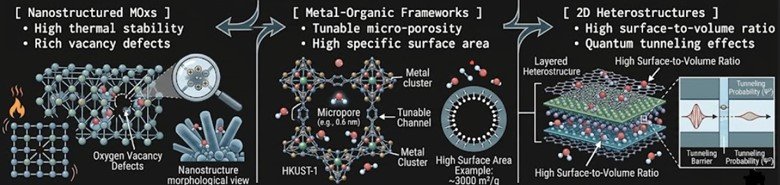
This article summarizes the structural design, manufacturing technologies and the technological landscape of high performance sensing materials for low moisture surroundings (RH). At levels of humidity that are very low, the usual network of water molecules disappears, and special interfaces have to be developed which are able to detect minute traces of water vapour. Three major classes of materials are investigated: nanostructured metal oxides (MOxs) that have oxygen vacancies as Lewis acid sites; highly crystalline, microporous Metal-Organic Frameworks (MOFs) with tunable pores for selective gas capture; and 2D materials or heterostructures (such as graphene oxide, MXenes) with high surface to volume ratios and sensitive electronic junctions. While accurate fabrication is essential to translating these materials into useful industrial sensors. The paper explains the substrate preparation that involves Interdigitated Electrodes (IDEs) with their geometric optimization and its effect on the electric field and signal to noise ratio. In addition, various solution deposition methods are investigated, from cost-effective solution processing (spin coating, drop casting) to high-precision direct writing (inkjet and 3D printing), and advanced atomically precise and high uniformity solution process (CVD and ALD) are evaluated. Lastly, a comprehensive performance matrix brings together a variety of sensor configurations and fabrication routes and various operational metrics.
Downloads
References
[1] Alam, Noor, and Yonggao Yin. "Design principles for ultra-low humidity sensors: a mechanism-oriented review." Journal of Materials Chemistry C (2025).
[2] Yoon, Jung-In, Chang-Hyo Son, Sung-Hoon Seol, and Ji-Hoon Yoon. "Perspective Chapter: Ultra-Low Temperature Chillers for Semiconductor Manufacturing Process." In Latest Research on Energy Recovery. Intech Open, 2021.
[3] Yin, Jiawen, Xiaohua Liu, Bowen Guan, and Tao Zhang. "Performance and improvement of cleanroom environment control system related to cold-heat offset in clean semiconductor fabs." Energy and Buildings 224 (2020): 110294.
[4] Jung, Hye-In, Chang-Hyo Son, and Joon-Hyuk Lee. "Optimizing the refrigerants in ultra-low temperature Semiconductor processing chiller with mixed Refrigerant." Case Studies in Thermal Engineering 61 (2024): 104864.
[5] Frendo, Daniel. "Analysis towards energy savings in dry storage systems of semiconductor devices." Master's thesis, University of Malta, 2021.
[6] yang, huabin, Qirui Zhang, Shuo Chen, Shuai Liu, Shuxin Chen, Qiming Guo, Guidong Chen et al. "An Ultra-Sensitive Humidity Sensor for Silent Speech Intelligent Recognition." International Journal of Extreme Manufacturing (2026).
[7] Kim, Bum Shik, Gi Baek Nam, and Ho Won Jang. "Airborne molecular contaminants sensors for high-yield and high-quality semiconductor manufacturing." Micro and Nano Systems Letters 14, no. 1 (2026): 5.
[8] Wen, Yu, Yi Liu, Su-Ting Han, Vellaisamy AL Roy, and Ye Zhou. "Humidity Sensing Systems: From Manufacturing to Intelligent Perception Applications." International Journal of Extreme Manufacturing (2026).
[9] Yang, Hongjing, Jiao Yang, Guangbo Li, Xucheng Li, and Dayang Ren. "Design and Implementation of a Lithography Chamber Environment Controller Based on Decoupling of Temperature and Humidity." World Scientific Research Journal 11, no. 11 (2025): 72-81.
[10] Fernicola, Vito, Giulio Beltramino, Antonio Castrillo, Rugiada Cuccaro, Regina Deschermeier, Volker Ebert, Diana Enescu et al. "Primary Trace Humidity Standards and SI-Traceable Trace Water Measurements in Ultra-High Purity Process Gases." (2026).
[11] Chen, Z., & Lu, C. (2005). Humidity Sensors: A Review of Materials and Mechanisms, SENSOR LETTERS Vol. 3, 274–295, (2005).
[12] Suchikova, Yana, Serhii Nazarovets, Marina Konuhova, and Anatoli I. Popov. "Binary Oxide Ceramics (TiO₂, ZnO, Al₂O₃, SiO₂, CeO₂, Fe₂O₃, WO₃) for Solar Cell Applications: A Comparative and Bibliometric Analysis." (2025).
[13] Das, Dipan Kumar, Padmaja Patnaik, Adya Andita Datta, Srikanta Moharana, Santosh Kumar Satpathy, and Sutripto Majumder. "Synthesis methods for doped metal oxides." Doping of Metal Oxides: From Fundamentals to Applications (2025): 51.
[14] Kumar, Pankaj, Amanjot Kaur Rahul, Puneet Kaur, and Jasmeet Kaur. "Structure, Properties and Application of Metal Oxide." In Metal Oxides, pp. 3-21. CRC Press, 2025.
[15] Sakeye, Motolani. "Metal oxides prepared through the nano casting approach-mechanistic study, surface interactions and applications in separation." (2016).
[16] Matović, Branko, Aleksandra Dapčević, Vladimir V. Srdić, and Zorica Branković. "PROGRAMME and the BOOK of ABSTRACTS." (2015).
[17] Schliesser, Jacob M. Development and Application of New Solid-State Models for Low-Energy Vibrations, Lattice Defects, Entropies of Mixing, and Magnetic Properties. Brigham Young University, (2016).
[18] Balakrishnan, Akash, Muthamilselvi Ponnuchamy, Ashish Kapoor, and Prabhakar Sivaraman. "Emerging contaminants in wastewater and associated treatment technologies." In Legacy and emerging contaminants in water and wastewater: monitoring, risk assessment and remediation techniques, pp. 231-261. Cham: Springer International Publishing, (2022).
[19] Ahmadi, Shahin, Shokufeh Aghabeygi, Majid Farahmandjou, and Neda Azimi. "The predictive model for band gap prediction of metal oxide nanoparticles based on quasi-SMILES." Structural Chemistry 32, no. 5 (2021): 1893-1905.
[20] Schliesser, Jacob M. Development and Application of New Solid-State Models for Low-Energy Vibrations, Lattice Defects, Entropies of Mixing, and Magnetic Properties. Brigham Young University, 2016.
[21] Lei, Chuxin, Weixin Guan, Yaxuan Zhao, and Guihua Yu. "Chemistries and materials for atmospheric water harvesting." Chemical Society Reviews 53, no. 14 (2024): 7328-7362.
[22] Li, Houqian, Dezhou Guo, Nisa Ulumuddin, Nicholas R. Jaegers, Junming Sun, Bo Peng, Jean-Sabin McEwen, Jianzhi Hu, and Yong Wang. "Elucidating the cooperative roles of water and lewis acid–base pairs in cascade C–C coupling and self-deoxygenation reactions." JACS Au 1, no. 9 (2021): 1471-1487.
[23] Chen, Ling, Jia-Wen Ye, Hai-Ping Wang, Mei Pan, Shao-Yun Yin, Zhang-Wen Wei, Lu-Yin Zhang, Kai Wu, Ya-Nan Fan, and Cheng-Yong Su. "Ultrafast water sensing and thermal imaging by a metal-organic framework with switchable luminescence." Nature communications 8, no. 1 (2017): 15985.
[24] Deng, Liming, Hongjun Chen, Sung-Fu Hung, Ying Zhang, Hanzhi Yu, Han-Yi Chen, Linlin Li, and Shengjie Peng. "Lewis’s acid-mediated interfacial water supply for sustainable proton exchange membrane water electrolysis." Journal of the American Chemical Society 146, no. 51 (2024): 35438-35448.
[25] Zheng, Fei, Chenghui Li, Yan Huang, Zhiyun Lu, Xiandeng Hou, and Yanju Luo. "Recent advances in optical heavy water sensors." Chemical Communications 61, no. 16 (2025): 3283-3300.
[26] Maurer, Manuela, and Chris Oostenbrink. "Water in protein hydration and ligand recognition." Journal of Molecular Recognition 32, no. 12 (2019): e2810.
[27] Dods, Matthew N., Simon C. Weston, and Jeffrey R. Long. "Prospects for simultaneously capturing carbon dioxide and harvesting water from air." Advanced materials 34, no. 38 (2022): 2204277.
[28] Mattigod, S. V. "Environmental and sensing applications of molecular self-assembly." Dekker Encyclopedia of Nanoscience and Nanotechnology 2 (2004): 1125.
[29] Cochard, Hervé, François Pimont, Julien Ruffault, and Nicolas Martin-StPaul. "SurEau: a mechanistic model of plant water relations under extreme drought." Annals of Forest Science 78, no. 2 (2021): 55.
[30] Esposito, Serena. "“Traditional” sol-gel chemistry as a powerful tool for the preparation of supported metal and metal oxide catalysts." Materials 12, no. 4 (2019): 668.
[31] Hussain M, (2026) Ultra-sensitive low-frequency dual-mode humidity sensor based on a composite of methyl red and PVA and graphene oxide, RSC Advances, 16(8), 5102-5111.
[32] Delipinar, T., Shafique, A., Gohar, M. S. & Yapici, M. K. (2021) Fabrication and Materials Integration of Flexible Humidity Sensors for Emerging Applications, ACS Omega, 6(13), 8744-8753.
[33] Paper-Based Humidity Sensors as Promising Flexible Devices: State of the Art: Part 1: General Consideration. Korotcenkov, G. Nanomaterials, 13(6): 1110.
[34] Comegna, Alessandro, Shawkat B. M. Hassan, and Antonio Coppola, "Development of a 3D-Printed Capacitive Sensor for Soil Water Content Estimation Using Nickel-Based Conductive Paint" Sensors 26, no. 5: 1494. (2026).
[35] Wang, Q. (2026). Fabrication, mechanism, performance and application of recent advances on flexible paper-based humidity sensors. Nanoscale Horizons, 11(3), 894-915.
Downloads
Published
Issue
Section
Categories
License
Copyright (c) 2026 Ronak Ali, Hassan Ali Soomro, Ali Raza Chachar, Khurram Iqbal, Abdul Qadir Rahimoon, Madad Ali Shah (Author)

This work is licensed under a Creative Commons Attribution 4.0 International License.
How to Cite