SCALABLE MACHINE LEARNING FOR TEMPERATURE-DEPENDENT CONVERSIONS IN COBALT-CATALYZED METHANE DRY REFORMING
DOI:
https://doi.org/10.71146/kjmr848Keywords:
Methane dry reforming, Cobalt catalyst, Machine learning, XGBoost ensemble, Temperature-dependent conversionsAbstract
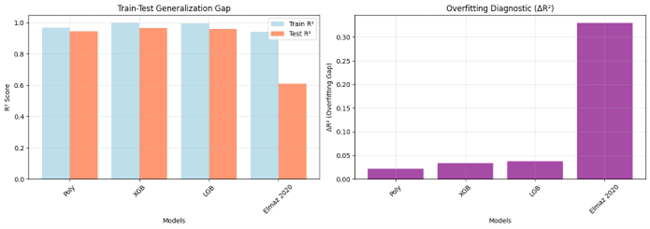
Predictions of methane dry reforming (DRM) over cobalt catalysts through machine learning have been limited by data sparsity, and the original 57-point benchmark has limited test accuracy (R2=0.42-0.67) because predictions and experimental measurements are overfitting on limited experimental measurements. The research generates a 402-point temperature-dependent dataset (550-750°C) that eliminates this fundamental tradeoff, providing ensemble forecasts with unprecedented R2=0.971 (CH4 conversion) and R2=0.958 (CO2 conversion), which are 70 and 80% better, respectively. Polynomial baseline gradient boosting (XGBoost/LightGBM) models outperform neural architectures by direct control over overfitting ( -2<0.055 vs 0.33-0.48), and SHAP analysis proves kinetic dominance of temperature (98.7% kinetic) allows single-sensor control of processes, compared to the complexity of multi-variable neural networks previously, while acceptable consistency of 10-fold cross-validation ( -2≈0.008) and production scale stability. The temperature-only model yields Arrhenius activation, kinetic acceleration, and equilibrium plateau with less than 2% accuracy, measuring the systematic 5-10% lag of CO2 in greenhouse gas fuels to achieve the desired yield plateau. This gracefully adequate design methodology makes frontier performances with 1/7th of the current literature 300–1000-point data requirements and multidimensional instrumentation requirements to deploy a digital twin of DRM, where research percent conversion accuracy translates to 0.15/kg of syngas cost reduction under real-world thermal gradient conditions of ±50oC. The open-source pipelines democratize entry, where the catalyst screening is guided, whilst the scale of datasets is defined to be the final choice in reproducible catalytic forecasting.
Downloads
Downloads
Published
Issue
Section
Categories
License
Copyright (c) 2026 Subhan Azeem, Nadeem Hassan, Muhammad Ashraf (Author)

This work is licensed under a Creative Commons Attribution 4.0 International License.
How to Cite