Stacked ANN Modeling for Catalyst Optimization and Methane Conversion Prediction in TRM
DOI:
https://doi.org/10.71146/kjmr843Keywords:
Tri-reforming of methane, stacked ANN, catalyst optimization, CH4 conversion prediction, syngas ratioAbstract
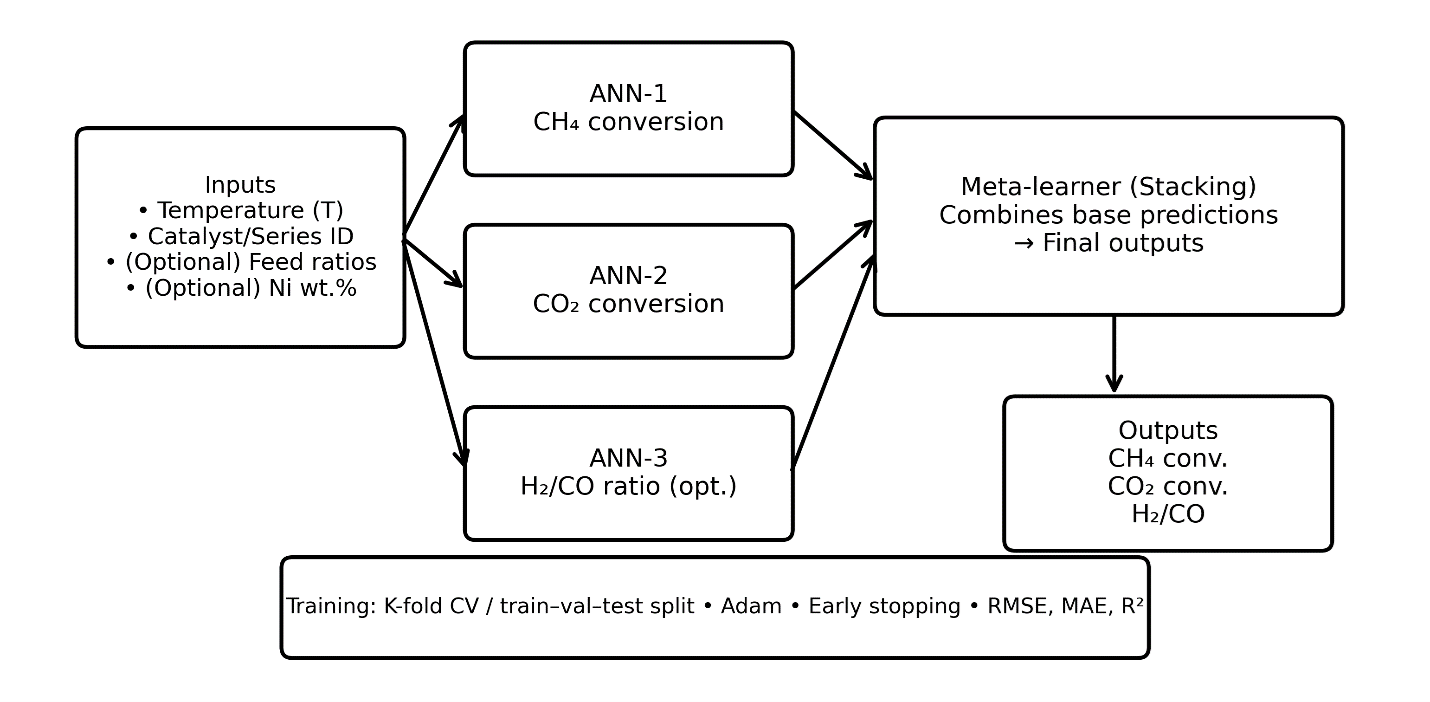
Tri-reforming of methane (TRM) is an attractive method to achieve syngas production out of biogas and flue gases, which combines dry reforming, steam reforming, and partial oxidation to produce tunable H2/CO ratios used in Fischer-Tropsch synthesis. Nevertheless, the catalyst deactivation through coking and sintering under mixed feeds requires commercialization to be hindered, and data-driven surrogates are required to elucidate interactions between multiple variables among heterogeneous datasets. This study presents a stacked artificial neural network (ANN) framework to predict CH4 conversion, CO2 conversion and H2/CO ratios based on the base learners trained by the data of component reaction (DRM, SRM, POX) to overcome the problem of data sparseness of TRM series, after preprocessing (wide to long reshaping, removing outliers, and standardization) to obtain unified input consisting of temperature (500-900oC) and the one-hot encoded series identifiers. Base ANN (ReLU hidden layers, Adam optimization) was used to generate the predictions, which were fed to a meta-learner (Ridge regression or shallow ANN) for ensemble blending. At under 4-fold cross-validation, the model converted CH4, CO2, and H2 RMSE of 2.5 +0.3, R2 0.985; CO2, H2 RMSE 3.1 +0.4, R2 0.972; and H2/CO 0.12 +0.02, R2 0.992, parity plots with >95% prediction in the error range of +5%, and unbiased residuals This interpretable, scalable surrogate is better than single-model baselines and fills literature gaps and provides a roadmap to hybrid ML-kinetics in the design of Ni-based TRM catalysts and process integration.
Downloads
Downloads
Published
Issue
Section
Categories
License
Copyright (c) 2026 Subhan Azeem, Nadeem Hassan, 3Muhammad Ashraf (Author)

This work is licensed under a Creative Commons Attribution 4.0 International License.
How to Cite