FACTORS CONTRIBUTING TO FEMALE MARGINALIZATION IN PAKISTANI HOUSEHOLDS: GENDERED PROBLEMS ENCOUNTERED BY WOMEN FROM PAKISTANI DIASPORA IN CANADA
DOI:
https://doi.org/10.71146/kjmr838Keywords:
Pakistani diaspora, mental health, South Asian women, female migration, matriarchy, domestic violence, intimate partner violenceAbstract
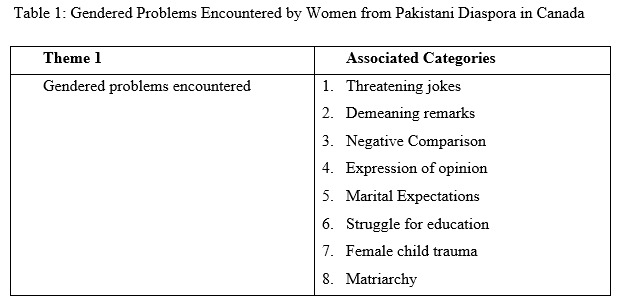
The present study aimed to explore the factors contributing to female marginalization in Pakistani households. Opinions and views of lived experiences of women from the Pakistani diaspora in Canada were gathered to analyze if their situation is any different from that of women residing in Pakistan and from the international migration theory suggested by Boyd and Grieco in 2003. Qualitative research using the phenomenological approach was used to investigate the lived experiences of eight Pakistani women from the most densely populated Pakistani neighborhoods across Canada. The study focused on elite urban women who were university educated or were enrolled in a university degree program. Thematic analysis has been used to analyze the data. Through data analysis on problems encountered, eight associated categories emerged: threatening jokes, demeaning remarks, negative comparisons, expressions of opinion, marital expectations, struggle for education, female child trauma and matriarchy. The study conducted is at the intersection of gender, migration, and racialization. Women from the Pakistani diaspora in Canada experience structural barriers that limit social participation, economic mobility, and mental well-being. Addressing these inequities requires policy frameworks that integrate mental health and social development supports, flexible labor market access, equitable representation, and empowerment-oriented education focused on rights and opportunities in Canada.
Downloads
Downloads
Published
License
Copyright (c) 2026 Taalia Khan (Author)

This work is licensed under a Creative Commons Attribution 4.0 International License.
How to Cite