EVALUATION OF WATER QUALITY AND HUMAN HEALTH RISK ASSESSMENT OF DRINKING WATER OF TALUKA BADIN, SINDH
DOI:
https://doi.org/10.71146/kjmr776Keywords:
Arsenic, heavy metals, drinking water, Chronic Daily Intake (CDI), Hazard Quotient (HQ), Hazard Index (HI), Atomic Absorption SpectrophotometerAbstract
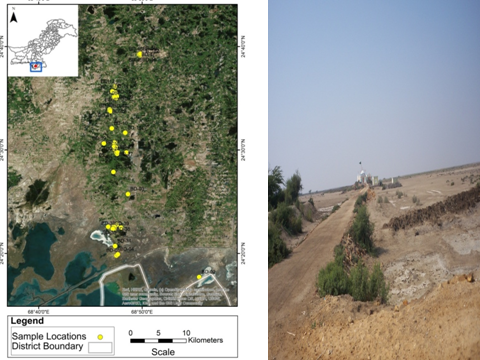
A total of 25 drinking water samples were collected in triplicate from six union councils of Taluka Badin. Various parameters were determined using standard laboratory methods. Parameters include pH, EC, TDS, chlorides, alkalinity, As, Cd, Cr, Co, Cu, Fe, Mn, Ni and Zn. Heavy metals were analysed using an atomic absorption spectrophotometer. The concentration ranges of heavy metals As, Cd, Cr, Co, Cu, Fe, Mn, Ni and Zn are given as 0.00–0.0145, 0.001–0.012, 0.013–0.040, 0.001–0.014, 0.056–0.329, 0.085–0.156, 0.030–0.150, 0.001–0.106 and 0.060–1.00 mg/L, respectively. To assess human health risk, the chronic daily intake (CDI), hazard quotient (HQ), hazard index (HI) and cancer risks were calculated. Non-carcinogenic risk was calculated by CDI, HQ, & HI, whereas carcinogenic risk was measured for arsenic, chromium, and nickel. Based on the findings, the drinking water in the coastal areas of Taluka Badin is contaminated with heavy metals, presenting a potential health risk to the population. The calculated cancer risk and hazard indices indicate the need for measures to improve drinking water quality in the region.
Downloads
Downloads
Published
License
Copyright (c) 2025 Abdul Raheem Shar, Prof. Dr. Ghulam Qadir Shar, Rubina Naz Mirani, Tahmina Fakhr-u-Nisa Abbasi, Sahib Ghanghro, Rabia Parveen Memon, Dr. Noorul Hassan Shar, Farzana Mangrio (Author)

This work is licensed under a Creative Commons Attribution 4.0 International License.
How to Cite